
India’s banking sector is moving rapidly toward intelligent, always-on financial services. UPI, mobile banking, digital lending, and real-time fraud monitoring create opportunities for Agentic AI but agents that can access financial records and invoke enterprise tools must be governed as carefully as employees and traditional applications.
For Indian banks, the challenge is not simply adopting artificial intelligence. It is combining AI-assisted decision-making with Zero Trust security, independent authorization, human oversight, and RBI-aware governance.
Can banks introduce autonomous AI without compromising customer trust and financial security? The answer lies in designing security and accountability into the architecture from the beginning.
1. Where Agentic AI Adds Value in Indian Banking
Unlike traditional chatbots, Agentic AI systems can coordinate multiple tasks, interact with enterprise applications, and support complex workflows.
Consider a suspicious UPI transaction. A conventional fraud detection system might generate an alert, while an AI-assisted investigation could:
- Identify suspicious patterns using existing fraud detection models.
- Retrieve relevant transaction records through authorized banking APIs.
- Correlate beneficiary accounts and previous fraud alerts.
- Generate an evidence-backed investigation summary.
- Recommend appropriate next steps and escalate consequential decisions to authorized banking personnel.
The objective is controlled intelligence, not unrestricted autonomy.
Other potential applications include KYC verification support, loan-document analysis, compliance monitoring, customer service, and operational risk management.
2. Why Zero Trust Becomes Essential for AI Agents
Zero Trust is built on the principle that access should never be granted solely because a request originates from a trusted network or application.
With Agentic AI, this principle extends to AI agents, their identities, the tools they invoke, and the information they retrieve. For a deeper explanation of workload identity and least privilege, see Zero Trust for AI agent identities.
For example, an AI agent investigating suspicious transactions may require read-only access to transaction histories. That does not mean it should automatically be permitted to freeze customer accounts, modify customer information, or approve financial transactions.
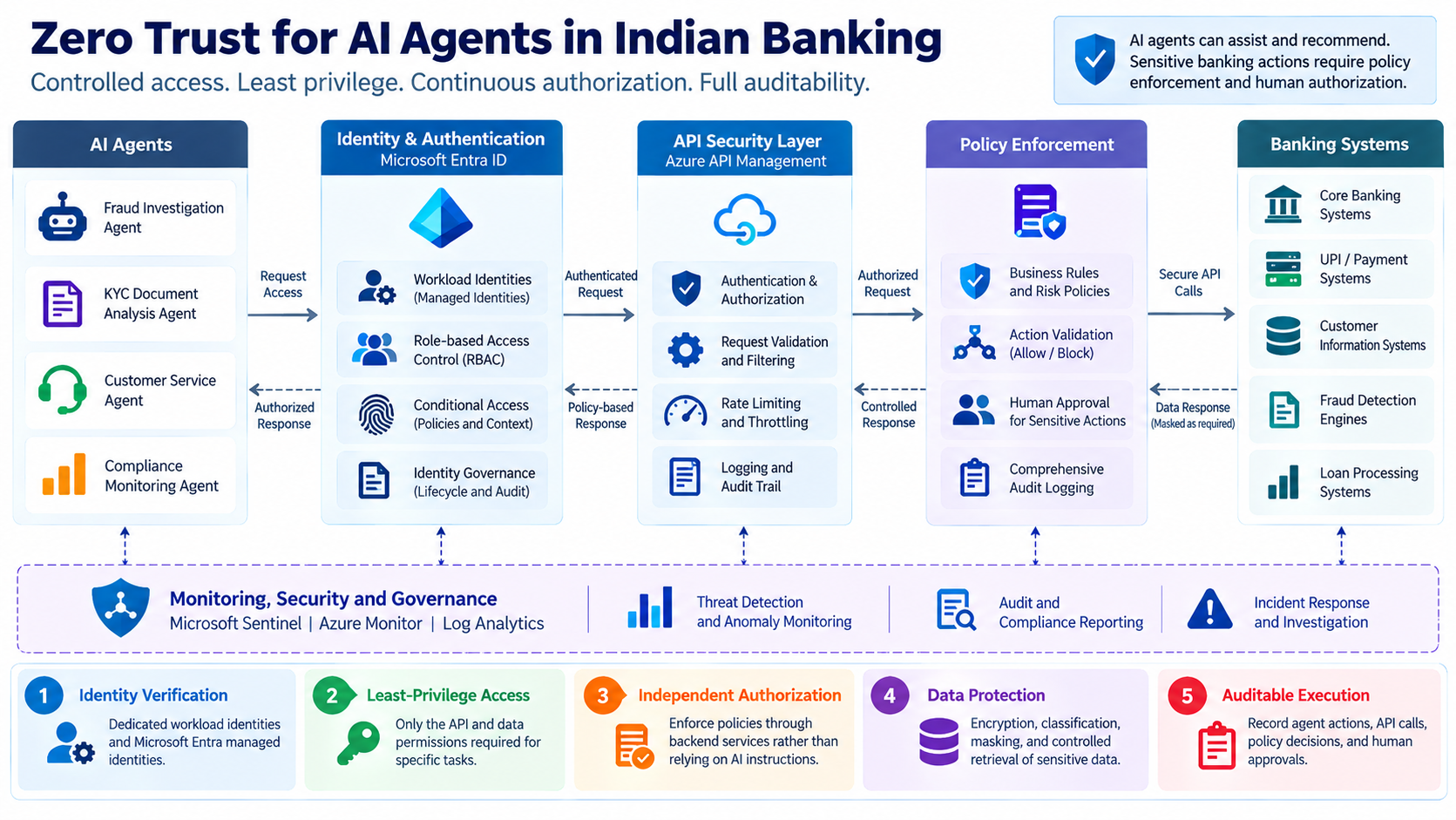
Five Essential Zero Trust Controls
- Identity verification: Use dedicated workload identities and Microsoft Entra managed identities where supported.
- Least-privilege access: Grant only the API and data permissions required for a specific task.
- Independent authorization: Enforce sensitive operations through backend authorization services rather than relying on AI-generated instructions.
- Data protection: Apply encryption, classification, masking, and controlled retrieval to sensitive financial information.
- Auditable execution: Record agent actions, API invocations, policy decisions, and human approvals.
Key architectural principle: AI agents may recommend actions, but sensitive banking operations must remain subject to deterministic policy enforcement and appropriate authorization.
3. Building a Secure Agentic AI Architecture on Microsoft Azure
Microsoft Azure provides services that can support secure AI orchestration, enterprise integration, identity governance, monitoring, and data protection.
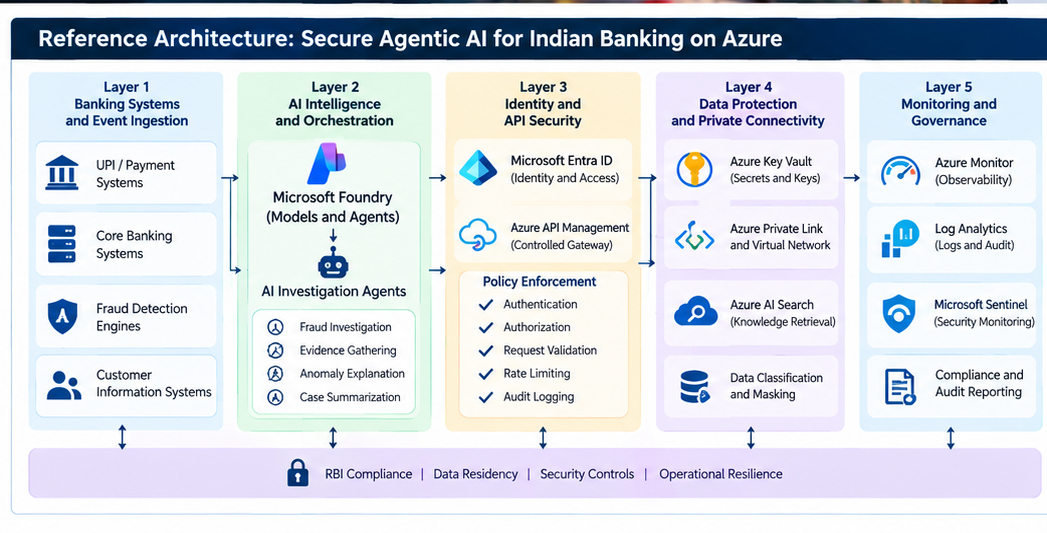
Layer 1: Banking Systems and Event Ingestion
Core banking platforms, UPI-related payment systems, transaction processing applications, and existing fraud detection engines remain the authoritative sources of banking information.
Azure Event Hubs can ingest approved transaction events, while Azure Functions or other processing components can route events into investigation workflows.
Data ingestion must follow applicable banking security, data residency, and regulatory requirements.
Layer 2: AI Intelligence and Orchestration
Microsoft Foundry can support AI model access and agent orchestration. The broader infrastructure and governance foundations are covered in the enterprise Gen AI landing zone architecture guide.
Specialized agents may perform evidence gathering, transaction investigation, anomaly explanation, and case summarization.
Existing fraud detection models should continue to provide primary risk scoring. Generative AI should support contextual reasoning rather than become the sole authority for financial decisions.
Layer 3: Identity and API Security
Microsoft Entra ID provides identity and access management capabilities.
Azure API Management can provide a controlled gateway between AI agents and banking APIs, supporting authentication, request validation, throttling, and applicable authorization policies.
Backend banking services must independently verify permissions before executing sensitive operations. For another example of deterministic control over AI actions, see Copilot Studio hooks and enterprise agent guardrails.
Layer 4: Data Protection and Private Connectivity
Azure Key Vault helps protect application secrets and cryptographic keys.
Azure Private Link and virtual network controls can reduce public network exposure where supported by the selected services.
Azure AI Search can support retrieval of approved investigation procedures and operational knowledge, provided application-level document authorization is enforced.
Layer 5: Monitoring and Governance
Azure Monitor, Log Analytics, and Microsoft Sentinel can support operational visibility, security monitoring, and incident investigation.
Important audit information includes:
- Agent identities and model versions.
- API requests and tool execution results.
- Authorization and policy decisions.
- Human approvals and overrides.
- Fraud investigation outcomes.
- Security incidents and abnormal agent behavior.
Architecture consideration: Validate regional availability, service-specific private networking, model processing locations, and data flows before selecting a production deployment.
4. Real-World Scenario: AI-Assisted UPI Fraud Investigation
Imagine a customer account suddenly transferring funds to multiple newly added beneficiaries.
An existing fraud detection engine identifies abnormal transaction patterns and triggers an investigation.
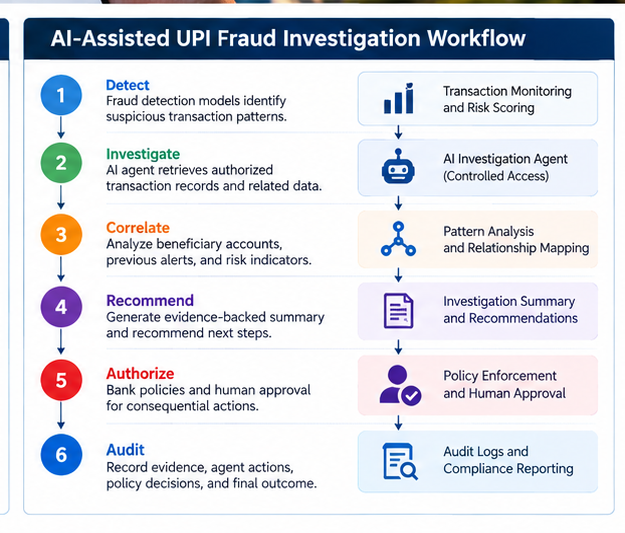
Step 1: Detect
The fraud detection system identifies unusual transaction velocity, beneficiary changes, or suspicious behavioral patterns.
Step 2: Investigate
An authorized AI agent retrieves only the transaction records permitted for the investigation.
Step 3: Correlate
The agent compares approved evidence with previous fraud alerts, transaction relationships, and known risk indicators.
Step 4: Recommend
The agent generates an evidence-backed case summary and recommends further investigation or escalation.
Step 5: Authorize
Any account restriction, payment hold, or other consequential action follows the bank’s established authorization and approval procedures.
Step 6: Audit
The system preserves investigation evidence, policy decisions, agent actions, and the final authorized outcome.
The key distinction: AI accelerates investigation, while the bank retains control over consequential financial actions.
5. RBI Governance: Responsible AI in Indian Banking
For Indian financial institutions, AI adoption must align with applicable Reserve Bank of India requirements and broader operational risk management expectations.
RBI FREE-AI Framework
In August 2025, the RBI published its Framework for Responsible and Ethical Enablement of Artificial Intelligence (FREE-AI) committee report.
The report provides recommendations intended to support responsible AI adoption across the financial sector.
It is important to distinguish the committee’s recommendations from binding regulatory requirements.
IT Governance and Outsourcing
Relevant RBI directions include:
- Information Technology Governance, Risk, Controls and Assurance Practices Directions, 2023.
- Outsourcing of Information Technology Services Directions, 2023.
- Storage of Payment System Data Directive, 2018, where applicable.
The applicability of these requirements depends on the regulated institution, services, and information being processed.
Data Residency and Cloud Architecture
Deploying an application in an Azure India region does not automatically establish RBI compliance.
Banks must assess:
- Customer and payment data storage locations.
- Cross-border processing and data transfers.
- Model inference and AI service processing locations.
- Backup and disaster recovery arrangements.
- Security monitoring and logging.
- Third-party service providers and contractual obligations.
- Operational resilience and incident response.
Regulatory governance must be designed into the banking architecture, not added after deployment.
6. Security Risks Indian Banks Cannot Ignore
Prompt Injection
Malicious instructions embedded in documents, messages, or retrieved information may attempt to manipulate AI agents.
Excessive Agency
Overly broad permissions can allow agents to perform actions beyond their intended responsibilities.
Sensitive Data Leakage
Prompts, retrieved documents, model responses, and operational logs may expose confidential financial information.
Agent Identity Misuse
Weak credential management or insufficient authorization controls may enable unauthorized API access.
Unreliable AI Decisions
AI-generated explanations may be incomplete, inaccurate, or unsupported by available evidence.
These risks require layered defenses, including strict tool allowlists, independent authorization, controlled retrieval, security testing, model evaluation, monitoring, and human oversight.
7. A Practical Adoption Roadmap for Indian Banks
The following controls help distinguish an advisory AI pilot from a production banking workflow:
| Control | Banking implementation |
|---|---|
| Identity | Dedicated agent identities with task-specific access |
| API authorization | Backend policy checks for every sensitive operation |
| Financial decisions | Human approval or established bank authorization workflow |
| Evidence | Traceable source records and auditable investigation outcomes |
| Operations | Monitoring, incident response and rollback procedures |
Phase 1: Advisory AI
Start with read-only AI assistants for fraud investigation summaries, internal knowledge retrieval, and operational support.
Phase 2: Controlled Agent Workflows
Enable approved API interactions using dedicated identities, least-privilege access, and auditable execution.
Phase 3: Human-Supervised Automation
Introduce controlled case creation, evidence gathering, and policy-governed recommendations with appropriate human approvals.
Phase 4: Risk-Based Expansion
Expand automation only after evaluating accuracy, security, regulatory requirements, operational resilience, and incident response readiness.
Each phase should include model monitoring, clear accountability, and rollback procedures.
Conclusion: Intelligent Banking Must Also Be Trustworthy Banking
Agentic AI has the potential to transform Indian banking by accelerating fraud investigations, improving operational efficiency, and helping institutions respond to increasingly sophisticated financial threats.
But intelligence without security creates risk.
And autonomy without accountability is unsuitable for critical financial systems.
By combining Microsoft Azure’s AI capabilities with Zero Trust principles, controlled API access, strong identity governance, and appropriate regulatory safeguards, Indian banks can build systems that are both innovative and resilient.
The future of banking will not be defined by how many AI agents an institution deploys. It will be defined by how securely, responsibly, and effectively those agents operate.
Frequently Asked Questions About Agentic AI in Indian Banking
How can Agentic AI help detect UPI fraud?
Existing fraud models identify suspicious patterns; AI agents can retrieve authorized evidence, correlate alerts and prepare investigation summaries. They should not independently authorize payment holds or account restrictions.
Why is Zero Trust important for banking AI agents?
AI agents can access sensitive data and invoke enterprise tools. Zero Trust requires verified identities, least-privilege access, independent policy checks and auditable actions for each workflow.
Does deploying Agentic AI in an Azure India region guarantee RBI compliance?
No. Banks must evaluate the requirements applicable to their activities, including payment data storage, service-provider arrangements, model processing locations, logging, backup and cross-border data flows.
Which Azure services support a secure banking AI architecture?
Depending on the solution, Microsoft Foundry, Microsoft Entra ID, Azure API Management, Azure Key Vault, Event Hubs, Azure Monitor and Microsoft Sentinel can contribute. Service capabilities, regional availability and private connectivity must be verified for the actual deployment.