Microsoft’s Azure Msv3 and Mdsv3 Medium Memory virtual machines add another option to the design space for large in-memory workloads such as SAP HANA.
For architects, however, the interesting part isn’t simply that Azure has another larger VM.
The real question is: what does the newer infrastructure change when we design SAP HANA on Azure?
Why this matters for SAP HANA
SAP HANA architecture is heavily influenced by memory capacity, certified VM sizes, storage performance and the recovery model.
As Azure introduces newer generations of memory-optimized infrastructure, organisations planning new SAP deployments—or refreshing existing environments—have an opportunity to revisit assumptions inherited from older M-series designs.
The Msv3 and Mdsv3 Medium Memory families use 4th-generation Intel Xeon Scalable processors and offer configurations approaching 4 TB of memory.
For larger HANA databases, this creates interesting possibilities around consolidation, vertical scaling and infrastructure lifecycle.
But bigger infrastructure doesn’t automatically mean we should deploy a bigger HANA VM.
1. More memory headroom doesn’t mean “choose the biggest VM”
HANA sizing should always start with the workload.
Before selecting a VM, I would look at:
- Current HANA database size
- Expected data growth
- Compression behaviour
- Peak memory consumption
- Memory required during operations such as delta merges
- Future application growth
The architectural opportunity with a newer VM generation is therefore not simply:
“How large a VM can Azure give me?”
A better question is:
“Can the newer VM generation simplify my architecture while giving the platform sufficient growth headroom?”
That distinction is important.
2. Don’t forget the storage architecture
With large-memory VMs, it is easy to focus entirely on CPU and RAM.
But SAP HANA performance still depends heavily on the storage architecture.
HANA data, log and shared volumes have different requirements for latency, throughput and durability. The VM capabilities, Azure storage configuration and platform limits therefore need to be evaluated together.
This becomes especially important during migrations.
Increasing compute capacity without validating the storage layer can simply move the bottleneck somewhere else.
For any Msv3/Mdsv3-based HANA design, I would validate the storage architecture and benchmark it against the requirements of the intended SAP workload rather than assuming the newer VM automatically improves the entire stack.
3. A bigger VM isn’t a High Availability strategy
This is probably the architectural point I would emphasise most.
A very powerful VM is still one VM.
Production SAP HANA architecture must continue to consider:
- Availability Zones
- HANA System Replication
- Cluster design
- Backup and restore
- Regional disaster recovery
- RTO and RPO requirements
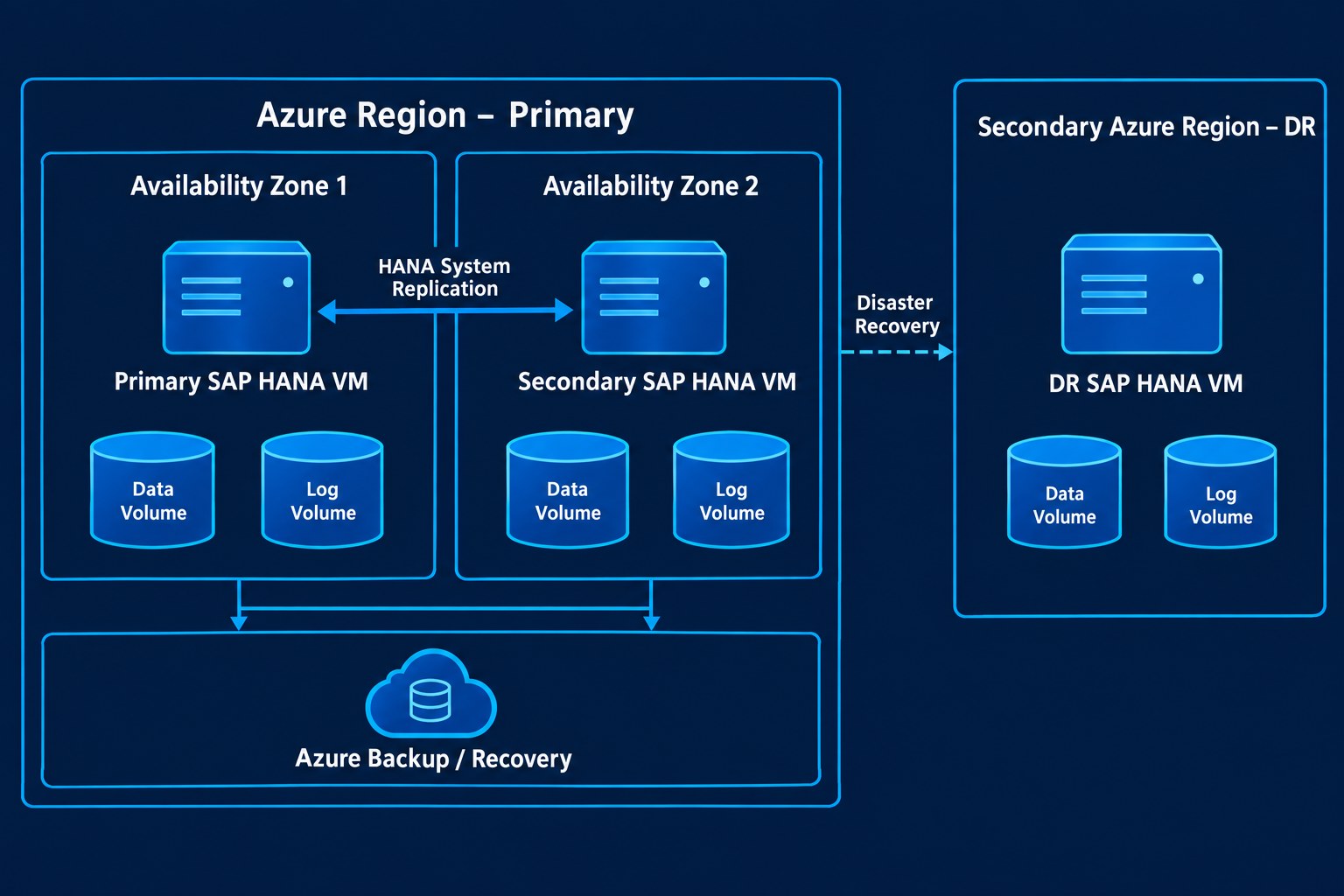
A new VM generation is actually a useful opportunity to revisit these decisions.
Instead of simply replacing an older M-series VM with its newer equivalent, ask whether the availability architecture itself still matches the business requirement.
4. Treat migration as an architecture change
For existing SAP environments, moving to Msv3 or Mdsv3 shouldn’t be approached as a simple VM resize.
Before committing to the target architecture, I would validate:
SAP certification
Check that the exact Azure VM SKU is certified for the intended SAP HANA workload.
Operating system support
Confirm that the target Linux distribution and version are supported for the selected SAP/HANA combination.
HANA compatibility
Validate the HANA version and revision requirements.
Storage
Re-evaluate data, log and shared storage rather than automatically carrying the existing design forward.
Networking
Review connectivity between HANA, SAP application servers, Azure services and on-premises systems.
Migration approach
Determine whether the move will use HANA System Replication, backup/restore or another supported migration method.
This may also be an opportunity to combine infrastructure refresh with HANA revision upgrades, OS lifecycle work or a wider SAP transformation.
However, combining too many changes into the same migration window increases risk.
Sometimes separating infrastructure migration from application modernization is the safer architecture decision.
5. Look at cost at the landscape level
Large-memory SAP workloads can become expensive very quickly.
But comparing only VM prices doesn’t give us the full picture.
The architecture should also consider:
- Azure Reservations
- Production versus non-production uptime
- Storage costs
- Backup
- Disaster-recovery infrastructure
- Software licensing
- Operational overhead
A newer, larger VM might enable consolidation and reduce the number of systems we operate.
But consolidation also increases the impact if that infrastructure fails.
The right question therefore isn’t:
“Which VM is cheaper?”
It is:
“Which architecture gives us the right balance between cost, resilience, performance and operational complexity?”
What I would validate before choosing Msv3 or Mdsv3 for SAP HANA
Before finalising the architecture, my checklist would include:
- ✓ SAP certification for the exact Azure VM SKU and HANA scenario
- ✓ Memory sizing with realistic growth and operational headroom
- ✓ Data and log storage throughput and latency
- ✓ Availability Zone and HANA System Replication architecture
- ✓ Backup, restore and disaster-recovery objectives
- ✓ Network connectivity to SAP application tiers and dependent systems
- ✓ OS and HANA version compatibility
- ✓ Reservation and lifecycle strategy for production and non-production workloads
Architect’s View
The most useful way to look at Azure Msv3 and Mdsv3 Medium Memory VMs is not as another Azure SKU announcement.
New infrastructure generations should be treated as an architectural checkpoint.
For a greenfield SAP deployment, that means designing around the capabilities available today instead of reproducing assumptions inherited from an older M-series architecture.
For an existing environment, it means asking whether moving to the newer generation can:
increase capacity headroom, simplify the landscape, improve the infrastructure lifecycle or create a better platform for the next few years.
But none of those benefits should come at the expense of availability, storage performance or recoverability.
And with SAP HANA, one rule remains particularly important:
Always design around the exact SAP-certified configuration and Microsoft’s current regional availability—not simply the headline specifications of a VM family.
Cloud Chronicles by Darthick — practical observations on cloud architecture, Azure and enterprise technology.
SAP HANA Validation Checklist
Before selecting a new Azure VM family, confirm the exact VM SKU is certified for the intended SAP HANA scenario and available in the required region. Review memory headroom, storage throughput, log latency, high availability and recovery requirements. A sizing exercise must include operating costs and operational support constraints, not just advertised RAM.
Document the decision owner, the evidence used for approval and the operating assumptions. Measure results against a baseline and define a rollback or recovery approach before making production changes.
Architecture Review Checklist
| Review area | What to validate |
|---|---|
| Security | Identity, least privilege and sensitive data handling |
| Reliability | Failure scenarios, monitoring and recovery |
| Cost | Measured demand, budgets and lifecycle costs |
| Governance | Ownership, approvals and audit evidence |
Frequently Asked Questions
Is the largest memory VM always the best choice?
No. SAP-certified sizing, recoverability, performance and regional availability should determine the configuration.
What should architects verify before production?
Confirm supported service configurations, test representative failure scenarios and document operational ownership, monitoring and escalation paths.