What is actually available
Plan hybrid infrastructure operations with AI-assisted troubleshooting while maintaining deterministic control-plane and audit boundaries across complex distributed enterprise environments.
For Azure solution architects and enterprise administrators, the crucial question when evaluating modern artificial intelligence extensions is not merely whether a capability exists within the platform portfolio. It is whether the capability can be deployed safely, operated consistently at massive scale, seamlessly integrated with the existing platform landing zones, and ultimately retired or rolled back without introducing unexpected operational surprises. This article presents a comprehensive, practical decision framework for evaluating, adopting, and governing Azure Copilot for Azure Local within your enterprise hybrid cloud architecture.
Hybrid cloud environments inherently introduce layers of complexity that traditional monitoring and management tools struggle to simplify. When managing hyper-converged infrastructure clusters that span on-premises data centers, edge locations, and connected Azure control planes, administrators frequently face fragmented diagnostic workflows. Azure Copilot for Azure Local steps into this operational landscape as an AI-powered assistant designed to streamline diagnostics, interpret complex log streams, and accelerate incident remediation. However, deploying generative AI tooling into core infrastructure tiers requires strict adherence to security baselines, predictable RBAC boundaries, and rigorous testing methodologies.
Hybrid control-plane considerations
Modern hybrid architectures demand high availability, low latency, and deterministic management. A sound adoption decision for AI-assisted operations must carefully consider identity federation, network boundaries, deployment automation pipelines, comprehensive logging structures, data classification rules, disaster recovery workflows, and total cost of ownership. Preview capabilities deserve additional, rigorous attention regarding service limits, data privacy commitments, and support tier agreements.
When organizations evaluate Azure Copilot for Azure Local, they are typically looking to bridge the skills gap between traditional infrastructure teams and modern cloud-native management planes. Infrastructure-as-a-Service (IaaS) and hyper-converged architectures generate vast amounts of telemetry, from storage pool metrics to cluster heartbeat logs. Sifting through these noisy log aggregations during a high-severity outage consumes valuable time. An integrated copilot can rapidly synthesize telemetry data, surface relevant Microsoft documentation, and suggest targeted troubleshooting steps. Nevertheless, architects must ensure that this diagnostic convenience does not introduce telemetry leakage, unauthorized privilege elevation, or compliance violations under frameworks like GDPR, HIPAA, or ISO 27001.
Operational readiness
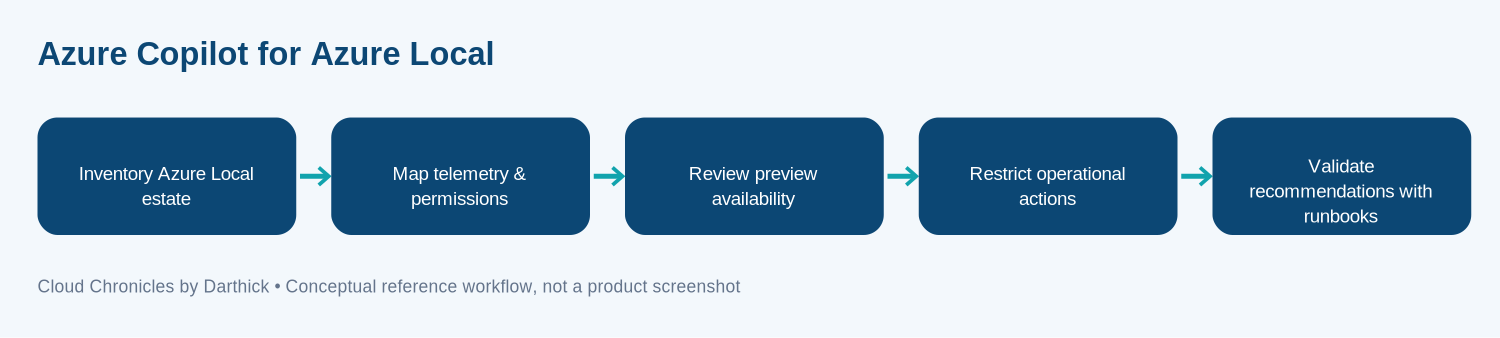
Implementing an advanced operational assistant requires a structured delivery flow that respects your organization’s enterprise scale and compliance mandates. The conceptual implementation sequence outlined below establishes a reliable pathway from initial scoping to steady-state operations.
Estate Inventory
Catalog all Azure Local clusters, associated hardware nodes, software versions, and connected management subscriptions.
Telemetry & RBAC
Map exact data flows, log analytics workspaces, and least-privilege role-based access control assignments.
Preview Scope
Review current preview service limits, regional availability matrices, and support SLA terms before broad rollout.
Action Guardrails
Restrict operational actions and establish automated approval gates for any mutating or destructive commands.
This flow is a conceptual implementation sequence, not a claim that the service exposes these exact steps as isolated native product features. Adapt each stage to fit your enterprise landing zone architecture and internal governance model.
Hybrid identity
Inventory Azure Local Estate
Cataloging your Azure Local estate is a foundational design and operational checkpoint. Organizations must explicitly define the resource owner, expected input and output parameters, potential failure modes, fine-grained access controls, and the specific audit evidence required before allowing production rollout. For this topic, apply the checkpoint to Azure Copilot for Azure Local, then carefully document the trade-offs between utilizing native managed cloud services versus custom-scripted local implementations.
Map Telemetry and Permissions
Mapping telemetry streams and identifying permission boundaries is a distinct design and operational checkpoint. Define the designated owner, expected input and output data structures, failure modes, access controls, and evidence required before proceeding to production rollout. For this topic, apply the checkpoint to Azure Copilot for Azure Local, then document the trade-offs between managed telemetry pipelines and proprietary auditing tools.
Review Preview Availability
Reviewing preview availability is a distinct design and operational checkpoint. Define the owner, expected input and output, failure modes, access controls, and evidence required before production rollout. For this topic, apply the checkpoint to Azure Copilot for Azure Local, then document the trade-off between managed services and custom implementation.
Restrict Operational Actions
Restricting operational actions is a distinct design and operational checkpoint. Define the owner, expected input and output, failure modes, access controls, and evidence required before production rollout. For this topic, apply the checkpoint to Azure Copilot for Azure Local, then document the trade-off between managed services and custom implementation.
Validate Recommendations with Runbooks
Validating recommendations with runbooks is a distinct design and operational checkpoint. Define the owner, expected input and output, failure modes, access controls, and evidence required before production rollout. For this topic, apply the checkpoint to Azure Copilot for Azure Local, then document the trade-off between managed services and custom implementation.
Control-plane dependencies
Security in hybrid AI deployments relies on absolute boundaries and strict identity management. Use Microsoft Entra ID identities wherever supported, enforce least-privilege Role-Based Access Control (RBAC), store managed secrets securely in Azure Key Vault, maintain explicit network trust boundaries, and aggregate structured audit logs centrally. Define a clear data retention policy, mandatory approval points for all consequential actions, and designate a primary incident response owner. Never expose sensitive credentials, connection strings, or tenant secrets in source code repositories or diagnostic telemetry streams.
Furthermore, data residency and sovereignty are paramount considerations when integrating AI tools into localized infrastructure. Azure Local instances often reside in regulated environments, such as financial institutions, healthcare facilities, or government installations. Ensuring that query inputs sent to the copilot engine adhere to compliance boundaries prevents inadvertent data exfiltration of personally identifiable information (PII) or proprietary telemetry.
Operational validation
Operational readiness requires rigorous testing of edge failure scenarios. Test system retries, partial network failures, API throttling limits, regional Azure control-plane unavailability, and rapid rollback procedures. Ensure that all side-effecting administrative operations are strictly idempotent. Continuously collect operational latency metrics, error rates, resource consumption figures, and underlying dependency health statuses. Create a definitive runbook that clearly states how to disable, isolate, or bypass the feature entirely without interrupting unrelated underlying workloads or core hyper-converged infrastructure functions.
When an Azure Local cluster loses connectivity to the global Azure cloud, a common scenario in disconnected edge deployments or remote industrial sites, cloud-dependent AI services may become temporarily unreachable. Architects must verify that localized management capabilities remain fully functional offline and that local automated scripts can pick up operational slack when cloud connectivity is severed.
Cost considerations
Deploying AI assistance across distributed hybrid architectures introduces variable cost structures that require proactive financial governance. Accurately estimate infrastructure expenses, API query usage fees, long-term storage requirements for audit logs, telemetry ingestion charges, cross-region networking tolls, and enterprise support tier additions. Always benchmark a representative pilot workload rather than projecting operational costs solely from vendor marketing examples or theoretical models.
Establish strict budget alerts within Azure Cost Management and assign precise resource tags matching your corporate cost center hierarchy. For preview products, verify current billing terms, consumption metering rules, and SLA commitments before approving broad production adoption to avoid unexpected financial overruns.
Final assessment
Azure Copilot for Azure Local should be rigorously evaluated as a substantive architectural capability rather than a superficial feature checkbox. Organizations must begin with clear operational requirements, carefully validate the current service contract, and adopt the technology incrementally, supported by empirical evidence gathered from a controlled pilot environment. By maintaining strict control planes, robust audit boundaries, and disciplined FinOps practices, enterprises can successfully harness AI-assisted hybrid operations without compromising infrastructure stability.
Useful references
Consult the official Microsoft Azure Local documentation and release announcements. Always verify the latest software version, API schemas, and related release notes before final publication or enterprise deployment.
More articles on Azure Cloud are available in the blog archive.