
Explain security cost allocation and forecast implications when Defender billing models evolve; verify actual SKU and effective dates against official telemetry and Microsoft documentation.
Find what you are paying for
For Azure solution architects and FinOps practitioners, the critical question is not merely whether a security monitoring capability exists. It is whether that capability can be deployed safely, operated reliably at scale, integrated smoothly into the existing landing zone architecture, and retired or rolled back without unexpected financial or operational surprises. This article presents a comprehensive decision framework for managing Defender for Cloud Workload Unit Billing.
As organizations scale their cloud footprints across multiple subscriptions, managing security posture becomes increasingly complex. Security tools are no longer isolated point solutions; they are core infrastructure components with direct budgetary impacts. When billing models shift toward workload units, enterprise architects must rethink how they forecast, allocate, and audit their cloud security spend. Understanding these consumption mechanics ensures that security coverage does not become a casualty of unmanaged cloud sprawl or unpredictable billing spikes.
Allocation and forecasting
Explain security cost allocation and forecast implications when Defender billing models evolve; verify actual SKU and effective dates. A sound adoption decision must consider identity management, network boundaries, deployment automation, logging pipelines, data classification standards, disaster recovery strategies, and total cost of ownership (TCO). Preview capabilities deserve additional attention regarding service limits, data egress implications, and enterprise support commitments.
Traditional cloud security billing models often relied on flat per-node pricing or straightforward core counts, which made forecasting relatively simple but occasionally penalized organizations running high-density container environments or microservices architectures. Workload unit billing introduces a more granular approach, aligning costs closer to actual resource utilization and threat surface exposure. However, this granularity requires architects to establish robust tagging strategies, automated resource discovery, and proactive cost governance.
Avoiding coverage gaps
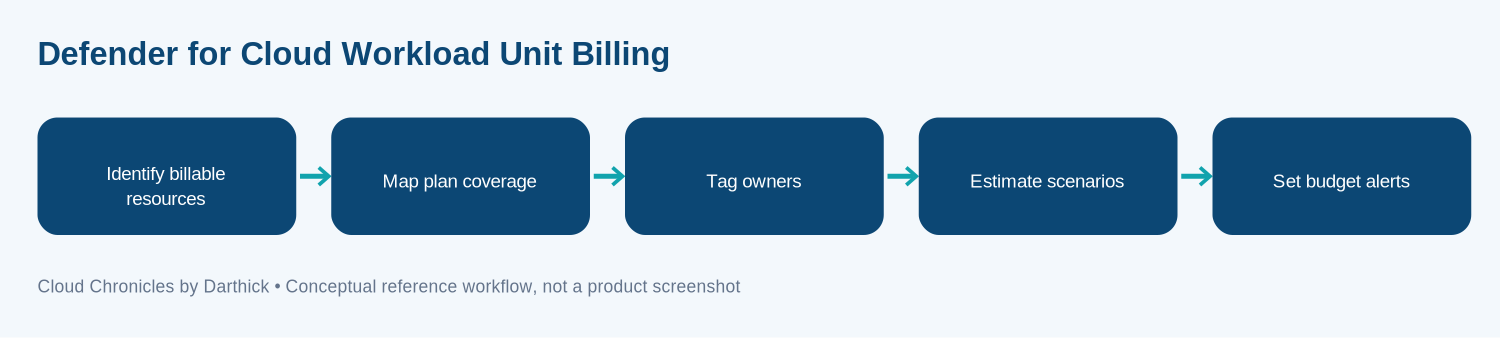
The diagram above illustrates a conceptual implementation sequence, rather than a claim that the service exposes these exact five steps as native, isolated product features. Enterprise architects should adapt this sequence to fit their specific organizational landing zone structure and central governance model.
Transitioning to workload unit billing requires a structured multi-phase approach. Stage one involves discovering and classifying billable assets. Stage two maps plan coverage across virtual machines, containers, and serverless components. Stage three applies precise cost center tags. Stage four models consumption scenarios under varied traffic loads. Stage five establishes automated budget alerts and anomaly detection mechanisms.
Inventory accuracy
Identify billable resources
Define resource owners, expected telemetry inputs, potential failure modes, access controls, and validation evidence before production rollout.
Map plan coverage
Align security plans with actual workload architectures, evaluating the trade-offs between broad tenant-level enablement and targeted resource grouping.
Tag owners
Enforce mandatory resource tagging policies to ensure security costs can be accurately attributed back to individual business units or product teams.
Estimate scenarios
Run mathematical consumption models to project workload unit consumption under peak transactional loads and unexpected scaling events.
Set budget alerts
Setting budget alerts represents the final operational checkpoint in our deployment blueprint. Define the responsible operations team, expected notification thresholds, automated remediation workflows, and audit trails required before releasing billing policies to production. For this domain, evaluate the trade-off between native cloud financial management tools and custom monitoring scripts.
Security coverage
Security governance must be woven into every layer of the workload unit billing architecture. Utilize Microsoft Entra identities wherever supported, enforce strict least-privilege Role-Based Access Control (RBAC), secure managed secrets within Azure Key Vault, maintain explicit network trust boundaries, and aggregate structured audit logs into a centralized security information and event management (SIEM) solution.
Furthermore, define a comprehensive data retention policy, establish clear approval gates for consequential infrastructure modifications, and assign an explicit incident response owner. Never expose connection strings, credentials, or sensitive billing telemetry in source code repositories or unencrypted configuration files. Compliance audits should regularly verify that access to cost management data is restricted to authorized financial and security personnel.
Chargeback model
Operational readiness requires rigorous validation against failure scenarios. Test automatic retries, partial network failures, API throttling limits, regional service degradation, and rollback procedures. Ensure all side-effecting automation scripts are fully idempotent. Continuously collect telemetry on latency, error rates, consumption metrics, and dependency health.
Organizations must maintain a dedicated runbook detailing precise steps to disable, isolate, or adjust the security feature without interrupting unrelated production workloads. Operational drills should simulate unexpected billing quota exhaustion to ensure that core application availability remains unaffected even if monitoring telemetry is temporarily throttled.
Budget monitoring
Effective financial operations (FinOps) require analyzing infrastructure, API usage, storage overhead, telemetry ingestion, networking egress, and support costs simultaneously. Benchmark a representative staging workload rather than relying exclusively on vendor-provided pricing examples or theoretical projections. Establish granular budget alerts and tag every cost center appropriately.
For preview products or newly introduced billing units, carefully verify billing calculation logic, contractual SLAs, and commitment discount applicability before committing to enterprise-wide production adoption. Regular cost-review meetings between cloud architects, security engineers, and finance teams help prevent billing surprises and ensure optimal return on security investment.
The practical takeaway
Defender for Cloud Workload Unit Billing must be evaluated as a fundamental architectural capability rather than a simple feature checklist item. Successful adoption requires beginning with clear operational requirements, validating the current service contract against enterprise needs, and rolling out changes incrementally backed by empirical evidence gathered during a controlled pilot phase.
Further reading
Consult the official Microsoft Defender for Cloud documentation for the latest technical specifications, SKU definitions, and release notes prior to implementing production billing changes.
More articles on Cloud Security are available in the blog archive.