
The attack and its blast radius
For Azure solution architects and enterprise engineering leads, the critical question surrounding modern artificial intelligence adoption is no longer whether a capability exists, but whether it can be deployed safely, operated at scale, integrated cleanly into existing governance platforms, and retired or rolled back without operational disruption. This article provides a definitive, highly practical decision and implementation framework for LiteLLM Supply Chain Security for Enterprise AI. As organizations increasingly adopt proxy gateways and unified routing layers to manage interactions with disparate large language models, the underlying dependencies of these gateways become prime attack surfaces that require rigorous protection.
Confirmed incident: LiteLLM’s October 23 root-cause analysis confirms that the litellm==1.107.0 PyPI release and associated container images were compromised on October 21, 2026. The malicious artifacts could execute credential-stealing code during Python startup, even without an application explicitly importing LiteLLM. If the affected version ran in your environment, investigate from a known-clean system rather than launching Python or pip inside the suspect environment; rebuild and rotate reachable credentials. See Microsoft Security Research for technical analysis.
Harden AI gateway dependencies and credential boundaries immediately after reported package supply-chain concerns. When dealing with complex python-based orchestration layers and inference proxies, verify all advisories against official repositories before citing affected versions in your remediation tickets. A sound enterprise adoption decision must comprehensively weigh identity management, network boundaries, deployment automation, structured logging, data classification, disaster recovery, and total cost of ownership. Preview capabilities demand additional scrutiny regarding service limits and support commitments before entering production environments.
To establish a resilient security posture, architects must look beyond perimeter defenses and inspect the entire software bill of materials. Modern AI infrastructure combines fast-moving open-source libraries with enterprise-grade cloud primitives. By enforcing strict vulnerability management, immutable artifact generation, and least-privilege network paths, teams can harness the speed of LiteLLM without inheriting the systemic risks of unvetted third-party dependencies.
How to check exposure safely
Enterprise AI deployments rarely talk directly to a single model provider. Instead, organizations deploy routing proxies like LiteLLM to handle load balancing, budget tracking, fallback routing, and unified API translation across Azure OpenAI, Anthropic, Cohere, and open-source models hosted on managed endpoints. While this centralization simplifies application code, it concentrates risk. If an inference proxy or one of its transitive Python dependencies is compromised via malicious package injection or typosquatting, attackers gain a privileged choke point capable of intercepting prompts, exfiltrating API keys, or poisoning inference outputs.
Security teams must evaluate supply-chain integrity through the lens of zero-trust architecture. Identity, network boundaries, deployment automation, logging, data classification, disaster recovery, and total cost of ownership form the pillars of this evaluation. Preview capabilities deserve extra operational attention due to rapid release cycles that may introduce breaking dependency changes or undocumented API shifts. By treating the AI gateway as a high-trust tier-zero component, platform engineering teams can insulate line-of-business applications from upstream vulnerabilities.
Containment and credential recovery
Deploying an inference proxy within an enterprise landing zone requires a structured delivery flow that spans artifact creation, secure transit, container registry validation, runtime isolation, and continuous auditing. The conceptual implementation sequence outlined here must be adapted to match your organization’s specific Azure landing zone and governance model.
The delivery pipeline begins in the developer workstation and secure source control repositories, where every pull request undergoes automated static application security testing (SAST) and software composition analysis (SCA). Once code is merged, container images are built using pinned base images and cryptographically signed using container signing tools. These artifacts are stored in an Azure Container Registry equipped with vulnerability scanning enabled on push.
Hardening the build pipeline
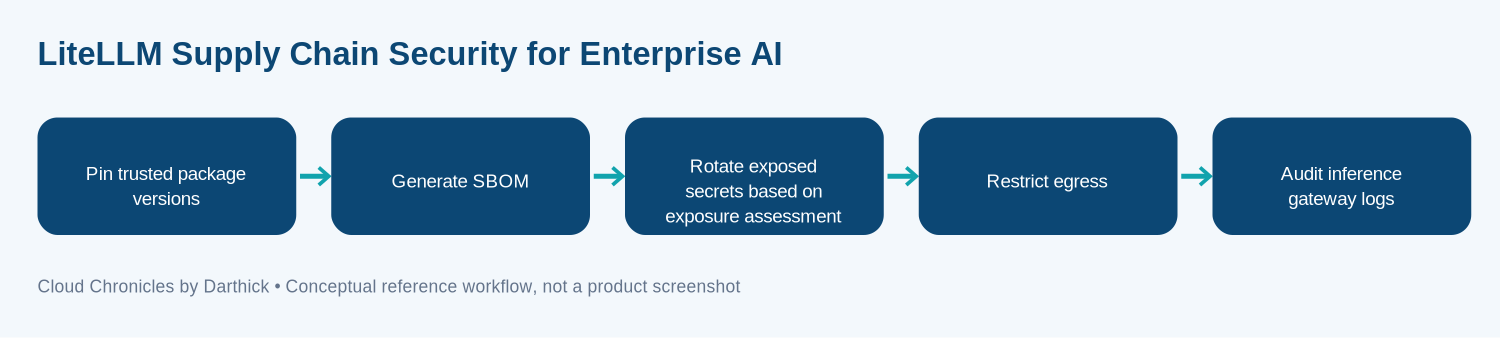
Pin Trusted Package Versions
Eliminate floating tag risks by locking exact Python package hashes and container digests across all deployment manifests.
Generate and Verify SBOM
Produce standardized CycloneDX or SPDX bill of materials during CI/CD to track every transitive dependency and component license.
Rotate Exposed Secrets
Implement automated credential rotation schedules and integrate Azure Key Vault references directly into runtime pods.
Restrict Outbound Egress
Lock down network firewalls to allow outbound connections only to verified model endpoint FQDNs, blocking unapproved telemetry.
Pin Trusted Package Versions
Pinning trusted package versions is a distinct design and operational checkpoint that prevents unauthorized or malicious code injection during the build phase. Engineering teams must define the designated owner, expected input and output, potential failure modes, access controls, and required audit evidence before any production rollout. For this topic, apply the checkpoint specifically to LiteLLM supply chain security for enterprise ai, and thoroughly document the trade-offs between fully managed proxy services and custom self-hosted container implementations.
When configuring dependency manifests, avoid broad version ranges such as caret or tilde constraints in Python requirements files. Instead, utilize strict hashing mechanisms (pip install –require-hashes) to ensure that downloaded packages exactly match cryptographic hashes verified during security reviews. This practice neutralizes repository compromise scenarios where an attacker publishes a malicious patch under an existing version number.
Generate Software Bill of Materials (SBOM)
Generating an SBOM is a vital operational control that provides complete visibility into the software supply chain. Define the responsible team, expected inputs, artifact outputs, failure handling, access boundaries, and verification evidence prior to production deployment. For enterprise AI gateways, the SBOM must encompass not only top-level Python packages but also underlying operating system libraries, C extensions, and container base image layers.
Integrate SBOM generation tools into your automated CI/CD pipeline using standard formats like CycloneDX. Store these generated artifacts in a secure, immutable repository linked to the specific image digest. In the event of a newly disclosed vulnerability in a transitive dependency, security operations teams can instantly query the SBOM database to determine whether the LiteLLM gateway is affected.
Rotate Exposed Secrets Based on Exposure Assessment
Rotating exposed secrets based on rigorous exposure assessment is a mandatory checkpoint for maintaining credential hygiene. Define ownership, triggers for rotation, expected inputs and outputs, failure modes, access permissions, and audit evidence requirements. In an AI gateway architecture, the proxy often holds high-privilege API keys for multiple foundational model providers.
Never store raw API tokens in environment variables stored in plain text configuration maps. Instead, inject secrets dynamically at runtime using Azure Key Vault Provider for Secrets Store CSI Driver or managed identity handshakes. Establish automated rotation cadences supported by webhook triggers that refresh upstream provider keys without causing gateway downtime.
Restrict Egress and Network Boundaries
Restricting outbound network egress is a critical defense-in-depth measure. Define the network owner, expected traffic flows, failure modes, access restrictions, and validation evidence before production rollout. Apply this checkpoint to prevent compromised packages from exfiltrating sensitive enterprise prompts or internal data to unauthorized external servers.
Configure Azure Firewall or Network Security Groups (NSGs) with strict User Defined Routes (UDRs). The LiteLLM gateway should only be permitted to communicate outbound with verified Azure OpenAI service endpoints, specific regional API domains of approved model vendors, and internal telemetry sinks. All other outbound traffic must be summarily dropped and logged for security review.
Audit Inference Gateway Logs
Auditing inference gateway logs closes the operational feedback loop. Define the log ingestion owner, expected telemetry schema, failure modes, access controls, and compliance evidence required before production rollout. Ensure that audit logs capture metadata, prompt token counts, routing decisions, and error codes without inadvertently logging sensitive PII or proprietary payload text unless explicit data governance policies permit.
Incident response controls
A robust security design relies on leveraging native cloud identity and access management primitives. Use Microsoft Entra identities wherever supported, enforce principle-of-least-privilege RBAC, store managed secrets in Azure Key Vault, establish explicit network trust boundaries, and maintain structured audit trails. Define clear data retention policies, approval workflows for consequential administrative actions, and an incident response owner. Crucially, ensure that credentials are never exposed in source code repositories, container image layers, or unsecured telemetry streams.
Governance frameworks must also address model usage quotas and budget guardrails. LiteLLM provides powerful mechanisms for rate limiting and per-user cost tracking. Integrating these features with Azure monitoring alerts ensures that anomalous query volumes or unexpected token consumption spikes are flagged immediately, mitigating both financial exposure and potential denial-of-service vectors.
Operational detection
High availability is paramount for enterprise AI gateways that power customer-facing applications and core internal workflows. Architects must test retries, partial failures, circuit breaking, throttling, regional unavailability, and rollback procedures thoroughly in staging environments. Make all side-effecting operations strictly idempotent.
Collect comprehensive telemetry covering latency, error rates, token consumption, and dependency health. Create a detailed operational runbook that explicitly states how to isolate, disable, or gracefully degrade the AI gateway feature without interrupting unrelated downstream workloads. Automated health probes should verify both the proxy container status and its ability to successfully negotiate authentication with upstream model endpoints.
The cost of containment
Enterprise AI deployments introduce complex financial models that span infrastructure, API usage, storage, telemetry, networking, and support costs. When projecting expenditures, benchmark a representative production workload rather than relying on vendor theoretical benchmarks alone. Set granular budget alerts and tag every resource with the appropriate cost center.
For preview products or newly introduced gateway features, verify billing structures and support SLA terms before committing to production adoption. Optimize token usage by implementing semantic caching layers within the gateway architecture to prevent redundant calls for frequently asked queries, directly reducing overall operational expenditure.
Final perspective
LiteLLM Supply Chain Security for Enterprise AI must be evaluated as an essential architectural capability rather than a simple feature checkbox. By starting with clear operational requirements, validating the current service contract, and adopting hardening practices incrementally with empirical evidence from a controlled pilot, enterprise architects can unlock the full potential of multi-model AI routing safely and sustainably.
Further reading
Microsoft Cloud Security Documentation and Fundamentals. Always verify the latest software version releases, CVE advisories, and related technical release notes before publishing enterprise configurations.
More articles on Cloud Security are available in the blog archive.