
Executive Summary and Core Architectural Scope
For Azure solution architects, the central engineering question is never merely whether a native capability exists in a given preview or general availability service. The true test of platform maturity is whether that capability can be deployed safely, operated reliably at scale, seamlessly integrated into an existing enterprise landing zone, and ultimately retired or rolled back without unexpected operational friction. This comprehensive architectural guide examines the practical considerations, risk vectors, and decision frameworks necessary for managing a Fabric Data Agent Integration Migration.
Confirmed integration deadline: Microsoft’s Fabric documentation states that the Foundry Agent Service integration using the Microsoft Fabric tool to connect to a Fabric data agent is unsupported starting November 6, 2026. The replacement is the Fabric IQ (OneLake Catalog) tool; this is not a blanket retirement of Fabric data agents. See Microsoft’s integration notice.
Migrating away from custom-tool implementations or transitioning deprecated agent connectors within Microsoft Fabric requires a disciplined approach. Organizations must systematically assess dependencies on Fabric Data Agent custom-tool integrations, evaluate modern platform alternatives, and plan a fully supported replacement strategy without prematurely assuming strict feature parity. As enterprise data ecosystems grow more complex, modernizing data architectures demands rigorous oversight across identity management, network boundaries, automated deployment pipelines, structured logging, granular data classification, disaster recovery protocols, and total cost of ownership calculations.
Preview functionalities demand heightened scrutiny from platform engineers and security officers alike. Because features in preview status frequently experience breaking API updates, shifting rate limits, and evolving compliance postures, architectural designs must isolate preview components behind robust abstraction layers. This ensures that if a deprecated connector or custom-tool integration is retired, downstream analytical consumers and business reporting workflows remain insulated from abrupt service interruptions.
Why Enterprise Architects Must Prioritize Migration Planning
When legacy integrations reach end-of-support milestones or undergo forced platform deprecation, organizations face immediate technical debt. Relying on makeshift patches or undocumented workarounds creates severe security vulnerabilities and operational blindness. A sound adoption and migration decision must account for the multi-faceted realities of enterprise cloud infrastructure.
Identity & Access Control
Enforcing Microsoft Entra ID boundaries, least-privilege role-based access control, and audited service principals across all agent touchpoints.
Network Perimeters
Establishing strict virtual network service endpoints, private link connections, and egress filtering to prevent unmonitored data exfiltration.
Telemetry & Logging
Centralizing query traces, error rates, and latency metrics into Azure Monitor and Log Analytics workspaces for comprehensive auditing.
Furthermore, technical teams must evaluate the total cost of ownership associated with migration efforts. Rebuilding custom tools natively within updated framework constraints involves development overhead, testing cycles, and retraining operational staff. By establishing a structured migration roadmap early, cloud governance boards can mitigate budget overruns and ensure business continuity.
The Integration Boundary That Changes
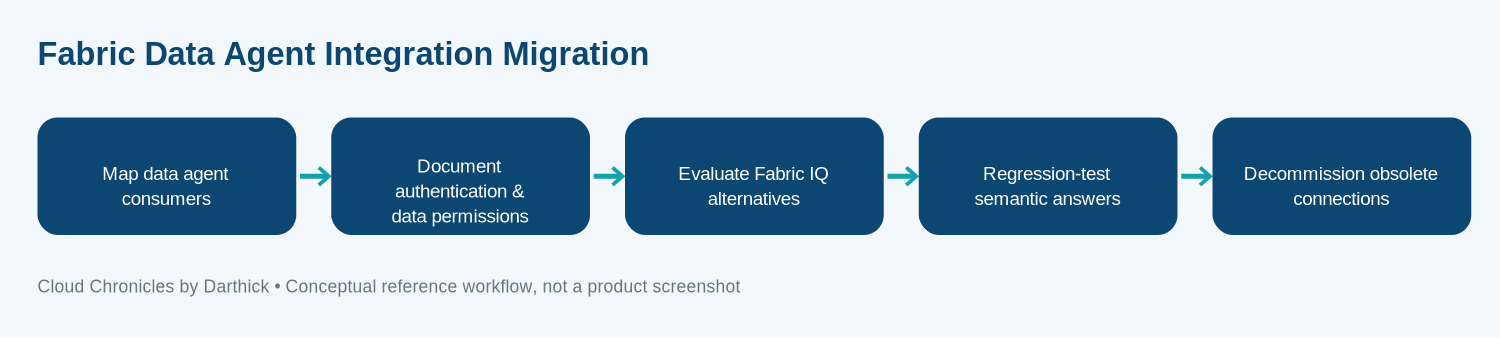
Implementing a stable migration path requires a clearly defined conceptual delivery sequence. Rather than treating integration migration as a single monolithic switchover, architects should approach the transition through a five-stage operational framework. This conceptual sequence provides structural clarity for engineering teams executing complex data platform modernizations.
The delivery flow begins with comprehensive asset discovery, inventorying every active data agent consumer, custom tool binding, and semantic model dependency within the tenant. Following discovery, teams establish secure authentication protocols and document granular data permissions. The third stage focuses on evaluating potential platform alternatives, including native Fabric IQ capabilities and managed semantic layers. Once an alternative is selected, rigorous semantic regression testing ensures output fidelity before the final stage decommissions legacy connections.
This staged methodology ensures that no critical dependency is overlooked during the transition. Every phase includes defined entry and exit criteria, establishing clear accountability across development, security, and operations teams.
What Fabric IQ Changes in Practice
Executing a seamless migration requires breaking down each stage into actionable, verifiable engineering checkpoints. Below is a detailed implementation blueprint designed to guide architects through the transition process.
Map Data Agent Consumers
Mapping data agent consumers is a distinct design and operational checkpoint. Every custom tool binding, API integration, and downstream analytical workflow must be identified and cataloged. Define the operational owner, expected input and output schemas, potential failure modes, access controls, and the exact evidence required before production rollout. For this topic, apply the checkpoint to fabric data agent integration migration, then document the trade-off between fully managed platform services and custom-built implementations.
Document Authentication and Data Permissions
Security architects must audit existing permission grants to ensure that legacy service accounts or overly permissive tokens are replaced with scoped Microsoft Entra identities. Define the owner, expected input and output, failure modes, access controls, and evidence required before production rollout. For this topic, apply the checkpoint to fabric data agent integration migration, then document the trade-off between managed services and custom implementation.
Evaluate Fabric IQ Alternatives
When retiring custom tool integrations, teams must rigorously evaluate native platform capabilities. Avoid assuming direct feature parity; instead, conduct structured proofs of concept to measure how modern semantic tools handle domain-specific queries. Define the owner, expected input and output, failure modes, access controls, and evidence required before production rollout.
Regression-Test Semantic Answers
Natural language processing and semantic query engines can produce subtle variations in output when underlying connectors change. Establish an automated testing framework comprising benchmark prompts and verified expected responses. Define the owner, expected input and output, failure modes, access controls, and evidence required before production rollout.
Decommission Obsolete Connections
Leaving inactive endpoints or legacy API keys active introduces unnecessary security surface area. Ensure all traffic has successfully migrated to the new architecture before revoking credentials. Define the owner, expected input and output, failure modes, access controls, and evidence required before production rollout.
Security, Governance, and Compliance Design
Enterprise data agents process highly sensitive corporate information, making security and governance paramount during any migration initiative. Organizations must enforce strict protective measures across the entire data lifecycle.
Whenever supported by the underlying services, use Microsoft Entra identities rather than shared connection strings or static keys. Implement strict least-privilege role-based access control models, ensuring that data agents can only access the specific semantic models and tables required for their authorized functions. All secrets, client IDs, and certificates must be stored securely within Azure Key Vault, utilizing automated rotation policies where applicable.
Network security boundaries must be explicitly defined. Route all agent communication through managed virtual networks, utilize private endpoints for data source connections, and enforce egress firewalls to block unauthorized external API calls. Structured audit logs must capture every query execution, access attempt, and configuration change. Furthermore, establish a clear data retention policy, mandatory approval gates for consequential automated actions, and designate an incident response owner to handle potential security anomalies swiftly.
Preserving Permissions and Data Contracts
High availability and operational resilience are non-negotiable for enterprise analytics platforms. During migration testing, engineering teams must simulate adverse operational conditions to validate system robustness under stress.
Test retry logic, partial failure scenarios, API throttling limits, regional service degradation, and rapid rollback procedures. Any side-effecting operation, such as data writes, state updates, or external webhook triggers, must be designed to be strictly idempotent to prevent duplicate processing during network retries. Comprehensive telemetry collection should track real-time latency, error rates, compute consumption, and dependency health across all integrated services.
Finally, engineering teams must author a detailed operational runbook. This document must state precisely how to disable, isolate, or reroute the data agent integration without interrupting unrelated analytical workloads or production reporting pipelines.
Testing and Cost Optimization
Cloud financial management requires accurate cost estimation before deploying modernized integrations into production environments. Relying solely on vendor pricing calculators or optimistic projections often leads to unexpected budget overruns.
Architects must comprehensively estimate infrastructure compute, API call volumes, underlying storage tiers, telemetry ingestion, inter-region networking, and ongoing support costs. To achieve accurate forecasting, benchmark a representative workload under realistic production query loads rather than relying on idealized vendor examples. Establish granular budget alerts, assign appropriate cost-center tags to all deployed resources, and regularly review consumption reports. For preview products and new platform features, verify billing structures, metering units, and service level agreement terms before committing to large-scale production adoption.
Plan Your Integration Migration Today
Explore expert resources and stay updated on data platform evolution.
More articles on Data & Analytics are available in the blog archive.