
Introduction and Executive Summary
For Azure solution architects and platform engineers, the most demanding moments often arrive without warning. When a critical zero-day vulnerability impacts transitive compression dependencies or core runtime environments, such as Brotli compression libraries integrated within .NET workloads, teams cannot rely on standard, leisurely deployment cadences. They require a rigorous, repeatable emergency patching playbook that operates seamlessly across Azure App Service, Azure Kubernetes Service (AKS), Virtual Machine scale sets, and containerized microservices. This article presents an architectural framework and operational checklist specifically designed for managing Brotli and .NET emergency patching on Azure.
The core challenge is balancing extreme urgency with operational safety. Rushing an emergency patch into production without proper asset inventory, validation checks, and rollback procedures can inadvertently cause catastrophic regressions, such as corrupted HTTP response streams, memory allocation spikes, or complete service outages. Solution architects must evaluate capability deployments not just by their immediate remediation potential, but by how safely they integrate with existing cloud governance models, network boundaries, identity providers, and continuous delivery pipelines. By adopting a structured decision framework, engineering teams can neutralize high-severity vulnerabilities without compromising platform reliability, security posture, or compliance mandates.
Understand the affected surface
When vendor advisories disclose vulnerabilities affecting compression libraries or .NET runtime components, the potential attack surface is often widespread. Brotli, widely praised for its superior compression ratios compared to Gzip, is frequently embedded as a native dependency or third-party NuGet package across modern cloud-native architectures. If a parsing vulnerability or memory safety flaw is discovered in these low-level streaming components, malicious actors can exploit internet-facing endpoints through crafted payloads, leading to denial of service, remote code execution, or information disclosure.
A sound adoption and patching strategy must consider more than just applying the vendor-supplied update. Enterprise architects must account for identity and access management, network boundaries, deployment automation pipelines, centralized logging, data classification standards, disaster recovery protocols, and total cost of ownership. Preview features or out-of-band runtime updates demand additional scrutiny regarding service level agreements, regional availability, and support commitments. Treating emergency patching as an isolated technical task rather than a holistic architectural exercise invites overlooked edge cases and prolonged incident recovery windows.
Containment before patching
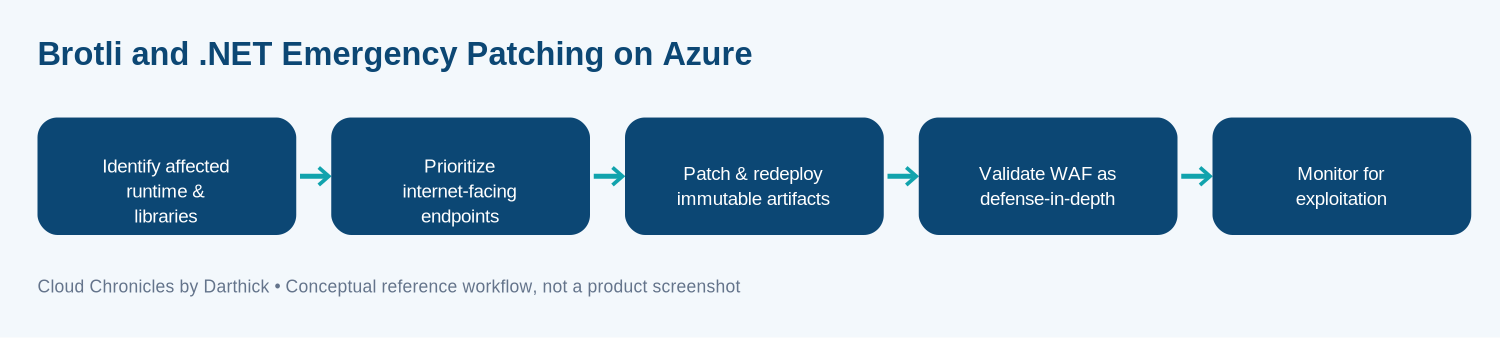
Implementing an emergency patch for .NET and Brotli dependencies across a complex Azure landing zone requires a clearly defined delivery flow. The conceptual architecture moves through five distinct phases, ensuring that code changes are systematically tracked, tested, and promoted rather than manually forced into production environments.
Inventory & Scan
Identify affected runtime versions and transitive package dependencies across all active Azure subscriptions.
Edge Prioritization
Isolate internet-facing endpoints and public APIs to apply immediate compensating controls and routing rules.
Immutable Redeploy
Compile patched source code into immutable container images or deployment artifacts for zero-downtime rolling updates.
WAF Validation
Verify Azure Web Application Firewall rulesets to ensure robust defense-in-depth against malicious payload delivery.
This conceptual implementation sequence represents a standardized operational pattern rather than a claim that Azure exposes these exact steps as a single turnkey product feature. Platform engineers must adapt this framework to fit their organization’s specific cloud adoption framework, landing zone structure, and enterprise governance policies.
Patch, rebuild and verify
To execute an emergency patch effectively, teams must follow a strict, phased implementation blueprint. Each stage represents a critical design and operational checkpoint designed to mitigate risk and verify system stability.
Identify Affected Runtime and Libraries
The initial checkpoint focuses on discovery. In large-scale enterprise environments, .NET applications are distributed across App Service plans, AKS clusters, and distributed container registries. Teams must define clear ownership for asset discovery, document expected input and output parameters, outline potential failure modes, enforce strict access controls, and gather required evidence before initiating any production modifications. When dealing with Brotli and .NET emergency patching on Azure, engineers must analyze whether the vulnerability stems from the core .NET SDK runtime, standard libraries, or a third-party NuGet package handling compression streams. Documenting the trade-off between fully managed Azure platform services and custom container implementations is essential during this discovery phase.
Prioritize Internet-Facing Endpoints
Not all workloads carry equal risk. Public-facing APIs, customer portals, and external integration endpoints must take absolute precedence during emergency patching cycles. This checkpoint requires establishing clear prioritization matrices to ensure that services exposed directly to the public internet are patched or shielded first. While internal microservices communicating within a secure virtual network subnet still require remediation, prioritizing perimeter entry points minimizes the immediate window of vulnerability. Architects must coordinate closely with security operations teams to ensure that traffic shaping or temporary rate-limiting measures do not inadvertently starve legitimate client traffic during the remediation window.
Patch and Redeploy Immutable Artifacts
Modifying running instances directly in production is an anti-pattern that introduces configuration drift and untraceable state errors. The patching process must rely strictly on immutable infrastructure principles. Developers update the vulnerable NuGet packages or base runtime images in source control, trigger automated CI/CD pipelines to build fresh container images or deployment packages, and promote these artifacts through staging environments to production. On Azure App Service, this involves swapping deployment slots or updating runtime stack configurations; on AKS, it involves rolling out updated pod deployment specifications with zero-downtime rolling update strategies.
Validate WAF as Defense-in-Depth
While patching the underlying code is the ultimate resolution, emergency deployments take time to build, test, and propagate. Validating and tuning the Azure Web Application Firewall (WAF) provides an immediate, critical layer of defense-in-depth. Security engineers should examine custom rules and managed rule sets within Azure Front Door or Application Gateway to block suspicious requests targeting known compression exploit vectors. This compensating control buys engineering teams the necessary breathing room to complete rigorous testing of the .NET patch without leaving backend services exposed to active exploitation attempts.
Monitor for Exploitation and System Health
The final operational checkpoint ensures continuous visibility before, during, and after the patch deployment. Teams must configure targeted log queries in Azure Monitor and Log Analytics to watch for anomalous HTTP status codes, elevated memory consumption, thread pool starvation, or unusual CPU spikes that might indicate an active exploitation attempt or a regression in the new compression logic. Establishing clear alerting thresholds ensures that incident responders are notified immediately if the patch introduces unexpected stability issues or performance degradation.
Security and Governance Design Considerations
Security must remain foundational throughout the emergency patching lifecycle. Teams should enforce Microsoft Entra ID for all management and workload identities wherever supported, adhering strictly to the principle of least-privilege role-based access control (RBAC). Secrets, connection strings, and cryptographic keys must never be hardcoded into source code repositories or configuration files; instead, they should be securely stored and retrieved dynamically from Azure Key Vault.
Explicit network trust boundaries must be maintained using private endpoints, service tags, and network security groups to isolate backend microservices from direct public access. Furthermore, comprehensive audit logs should capture every deployment action, configuration change, and administrative access event to satisfy internal compliance mandates and external regulatory requirements.
What to monitor afterward
Emergency patches carry inherent risks. To ensure high availability, platform engineers must test retry logic, partial failure scenarios, throttling behavior, and regional failover mechanisms before pushing changes to production workloads. Side-effecting operations within deployment scripts must be fully idempotent to prevent partial state corruption if a pipeline fails mid-execution.
Comprehensive telemetry collection is essential. Teams must monitor application latency, error rates, CPU/memory consumption, and dependency health metrics continuously. Crucially, every emergency deployment must be accompanied by a well-documented rollback runbook. This operational guide must explicitly state the exact steps required to isolate the feature, revert to the previous container image or runtime version, and restore normal service operations without interrupting unrelated business workloads.
Runtime and dependency controls
While security fixes take precedence during an emergency, financial governance cannot be completely ignored. Deploying emergency patches often involves scaling out redundant environments, running parallel staging slots, or increasing Azure Monitor log ingestion volumes. Solution architects should benchmark representative workloads to estimate infrastructure, API usage, storage, and networking costs accurately rather than relying solely on vendor projections.
Setting up proactive budget alerts and applying precise cost center tags to all resources involved in the patching pipeline ensures financial accountability. For workloads utilizing preview services or out-of-band runtime patches, teams must carefully verify billing terms, support commitments, and potential data egress fees before committing to long-term production deployments in regional Azure data centers.
Final perspective
Managing Brotli and .NET emergency patching on Azure requires treating security updates as a core architectural capability rather than a reactive feature checkbox. By establishing clear operational requirements, validating service contracts, and adopting changes incrementally supported by empirical evidence from controlled pilot environments, engineering teams can maintain a resilient, highly secure cloud posture.
Further reading
To verify the latest version details, official security advisories, and related release notes before publication, consult the official Microsoft .NET documentation and release announcements.
More articles on Cloud Security are available in the blog archive.