
What the API actually provides: Microsoft’s Decisions API documentation describes a dedicated /openai/v1/decisions endpoint for typed predicate, choice, and score questions. The current documentation lists gpt-6-luna as the supported model and notes region-dependent rollout. It is a decision-evaluation interface, not a substitute for transaction authorization or deterministic business rules.
What a decision endpoint returns
As enterprise adoption of generative artificial intelligence shifts from exploratory proof-of-concept stages to mission-critical production environments, software architects face a fundamental architectural challenge: how to transition from open-ended, probabilistic text generation to deterministic, policy-compliant business decisions. Traditional software systems rely on rigid conditional logic, relational data integrity, and deterministic execution paths. In contrast, large language models (LLMs) operate on probabilistic token distributions, semantic associations, and generative outputs that can occasionally introduce ambiguity or hallucinations.
To bridge this architectural gap, organizations implementing Azure OpenAI services require a sophisticated design pattern that marries the immense cognitive flexibility of modern LLMs with strict business rule enforcement, comprehensive audit logging, and multi-tiered approval workflows. This guide unpacks the foundational principles, design vectors, implementation blueprints, and operational checklists required to architect a robust decision-making system on Microsoft Azure.
Keep authority outside the model
Explore decision-oriented AI patterns with explicit policies, observability, and human approvals; validate product scope and naming before publishing enterprise workloads. A sound adoption decision must evaluate multiple intersecting dimensions: identity governance, network isolation boundaries, continuous deployment automation, distributed logging, data classification tiers, disaster recovery preparedness, and total cost of ownership (TCO).
When enterprise stakeholders evaluate advanced cloud-native architectures, they frequently underestimate the operational overhead associated with governance. Preview capabilities and specialized API patterns deserve heightened scrutiny regarding service-level agreements (SLAs), API rate limits, regional data residency commitments, and long-term support lifecycles. Designing a system without these considerations baked into the foundation often leads to expensive re-architecting down the road.
Furthermore, decision-oriented AI systems rarely operate in an isolated vacuum. They typically sit at the intersection of enterprise resource planning (ERP) databases, customer relationship management (CRM) platforms, and identity providers. Consequently, an architectural failure in the AI decision tier can propagate upstream corruption or invalid automated actions across connected business systems. Establishing strict boundary conditions is therefore not merely a best practice, it is an absolute architectural prerequisite.
Testing decisions in production
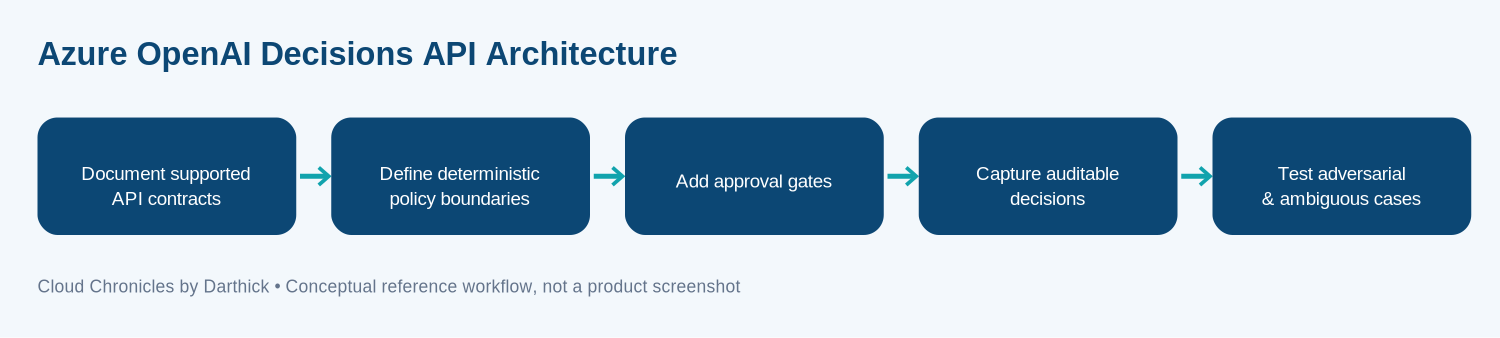
The diagram above outlines a conceptual implementation sequence rather than a claim that Azure exposes these exact five steps as native, single-button product features. Solution architects must adapt this mental model to their specific corporate landing zone architecture, enterprise governance models, and regulatory compliance requirements.
The delivery flow is structured around five sequential phases:
- Phase 1: Ingestion and Normalization: Raw inputs, user prompts, and transactional metadata enter through secure API gateways.
- Phase 2: Policy Interception: Deterministic business rules and schema validations screen the input before it ever touches foundational models.
- Phase 3: Cognitive Evaluation: Azure OpenAI endpoints process the sanitized prompt, leveraging custom semantic search or fine-tuned weights.
- Phase 4: Human-in-the-Loop Validation: Consequential recommendations route through approval gates when confidence scores fall below established thresholds.
- Phase 5: Auditable Execution: Immutable records of the decision rationale, prompt payload, model version, and approver identity are committed to secure storage.
Policy enforcement
To operationalize this architectural pattern effectively, engineering teams should execute a rigorous validation checkpoint methodology. Each checkpoint defines specific ownership boundaries, input-output contracts, failure recovery mechanisms, access controls, and audit evidence requirements.
Document Supported API Contracts
Define strict JSON schemas for inputs and outputs, document failure modes, and evaluate the trade-offs between managed Azure services and custom microservice implementations.
Define Deterministic Policy Boundaries
Enforce hard boundaries using code-based validation layers to filter out invalid prompts and ensure model outputs adhere strictly to regulatory compliance rules.
Add Approval Gates
Implement multi-tier human review checkpoints for high-risk or ambiguous decisions, preventing autonomous downstream execution without explicit sign-off.
Capture Auditable Decisions
Log every transaction, model parameter set, prompt hash, and human override into append-only storage to satisfy strict enterprise audit requirements.
Document Supported API Contracts
Documenting supported API contracts is a foundational design and operational checkpoint. Enterprise architects must define the exact service owner, expected input payloads, output data schemas, cascading failure modes, role-based access controls, and compliance evidence required prior to any production rollout. When designing around Azure OpenAI endpoints, engineering teams must carefully weigh the architectural trade-offs between utilizing fully managed platform-as-a-service (PaaS) capabilities versus building custom orchestration layers in containerized environments.
Define Deterministic Policy Boundaries
Because large language models are inherently non-deterministic, defining deterministic policy boundaries is critical for mitigating systemic risk. Software systems cannot leave business-critical validations to chance. By sandwiching LLM inference calls between programmatic input sanitization filters and strict output schema validators (such as JSON mode enforcement or regex-based pattern matching), architects ensure that malformed or policy-violating responses are intercepted and rejected before causing downstream anomalies.
Add Approval Gates
Not all decisions carry equal weight. Low-risk informational queries can safely execute autonomously, whereas high-consequences transactions, such as financial loan approvals, healthcare triage adjustments, or automated infrastructure modifications, demand human oversight. Adding approval gates into the workflow architecture ensures that human experts can inspect model rationale, examine confidence intervals, and approve or reject actions before side-effects occur in production.
Capture Auditable Decisions
Enterprise governance frameworks and regulatory bodies mandate complete traceability for automated decision systems. Capturing auditable decisions requires persisting not just the final output, but the complete lineage: the originating user identity, timestamp, exact prompt text, retrieved context chunks, model version, system prompts, and any manual override notes. This immutable trail enables forensic investigation and continuous model tuning over time.
Test Adversarial and Ambiguous Cases
Before releasing decision APIs to production, comprehensive testing against adversarial prompts, prompt injection attempts, and intentionally ambiguous inputs is mandatory. Simulating boundary-pushing scenarios helps engineering teams discover where model confidence degrades and ensures that fallback mechanisms gracefully handle edge cases without crashing the host application or exposing sensitive internal telemetry.
Audit and observability
A secure Azure OpenAI architecture must leverage defense-in-depth principles across every layer of the cloud topology. To protect sensitive corporate intellectual property and customer data, architects should implement the following core security controls:
- Identity and Access Management: Authenticate all service interactions using Microsoft Entra ID (formerly Azure Active Directory) wherever supported. Avoid long-lived API keys in favor of managed identities and token-based authentication.
- Least-Privilege RBAC: Assign granular Role-Based Access Control permissions to engineering teams and backend services, restricting who can deploy models, modify system prompts, or access audit logs.
- Secret Management: Store connection strings, database credentials, and cryptographic keys in Azure Key Vault, utilizing automatic rotation policies and private endpoint connectivity.
- Network Perimeter Defense: Deploy Azure OpenAI accounts within virtual networks (VNets) using private endpoints, disabling public internet access entirely for sensitive enterprise environments.
- Structured Logging and SIEM Integration: Streamline operational telemetry and security events into Azure Monitor and Microsoft Sentinel for real-time anomaly detection and compliance reporting.
Latency and cost
Mission-critical AI architectures must be engineered to withstand transient cloud outages, downstream API throttling, and regional degradation. High availability is achieved not by relying on single-region infrastructure, but by designing resilient software patterns:
Engineers must implement robust retry policies with exponential backoff and jitter to handle HTTP 429 (Too Many Requests) and HTTP 503 (Service Unavailable) responses gracefully. Furthermore, side-effecting operations, such as writing to external billing systems or updating customer records, must be rendered strictly idempotent to prevent duplicate processing during retries or partial network failures.
Operational readiness also requires comprehensive observability. Teams should monitor token consumption rates, p95/p99 latency metrics, error frequencies, and upstream dependency health. Finally, every production deployment must include a well-tested runbook detailing how to isolate or disable the AI decision layer instantly without causing downtime for unrelated core platform workloads.
Release criteria
Generative AI workloads can introduce unpredictable cloud expenditure spikes if cost governance is neglected. A comprehensive FinOps strategy for Azure OpenAI decisions architecture evaluates several key financial vectors:
Architects must benchmark representative workloads using production-grade test payloads rather than relying solely on vendor marketing projections. Setting up Azure Budgets with automated alert thresholds and strict cost center tagging ensures financial accountability across product teams.
Where I would draw the line
Azure OpenAI Decisions API Architecture should be evaluated fundamentally as an enterprise architectural capability rather than a simple feature checkbox. Achieving sustainable success requires starting with crystal-clear operational requirements, validating current service contracts, and adopting advanced AI patterns incrementally backed by empirical evidence gathered during controlled pilots.
Sources and documentation
Consult the official Microsoft Azure documentation and Foundry announcements. Always verify the latest API versioning, regional rollouts, and related release notes prior to enterprise production publication.
More articles on Gen AI are available in the blog archive.