
For Azure solution architects evaluating advanced artificial intelligence workloads, the critical question is not merely whether a platform capability exists. It is whether that capability can be deployed safely, operated at massive scale, seamlessly integrated with an existing enterprise landing zone, and retired or rolled back without causing cascading system failures. This comprehensive guide presents a practical architectural decision framework, implementation blueprint, and operational checklist for Managed Fine Tuning and Multi LoRA in Foundry on Azure.
When tuning is worth it
Enterprise organizations frequently reach a tipping point where generic foundation models, even when augmented with advanced retrieval techniques, fail to capture the precise domain vocabulary, tone, complex regulatory constraints, or structured output formats required for core business processes. When prompt engineering and Retrieval-Augmented Generation (RAG) hit their functional ceilings, customization becomes mandatory. However, full-model fine-tuning introduces severe operational burdens, including prohibitive infrastructure costs, massive storage overhead for independent model checkpoints, and complex serving topologies.
Managed Fine Tuning and Multi LoRA (Low-Rank Adaptation) within the Foundry ecosystem provide a middle ground. By decoupling the frozen base model weights from lightweight, task-specific adapter layers, engineering teams can host dozens or hundreds of specialized operational variants on a single shared GPU inference cluster. This architecture dramatically cuts memory footprints, reduces infrastructure expenditure, and accelerates deployment velocity. Yet, realizing these benefits requires rigorous architectural planning across identity management, network boundaries, CI/CD pipelines, observability tooling, and automated rollback strategies.
Data and adapter lifecycle
Comparing adapter-based specialization with retrieval-augmented generation and full fine-tuning reveals distinct operational trade-offs. While RAG excels at injecting dynamic, frequently updated factual knowledge, it often struggles with deep stylistic alignment, complex reasoning patterns, or strict adherence to proprietary schema definitions. Conversely, full fine-tuning reshapes the entire parameter space of a foundation model, leading to catastrophic forgetting of general capabilities if not managed with extreme care, alongside unsustainable serving costs when running separate instances for every internal business unit.
Multi-LoRA serving changes this economic equation by maintaining a single immutable base model in high-speed GPU memory while dynamically loading and swapping small adapter matrices, often constituting less than one percent of total parameters, on demand during inference routing. For Azure architects, a sound adoption decision must evaluate identity federation, network isolation via private endpoints, deployment automation through infrastructure-as-code, structured telemetry, data classification standards, disaster recovery workflows, and total cost of ownership. Preview features demand heightened vigilance regarding service limits, API stability commitments, and support SLA terms.
Serving multiple adapters
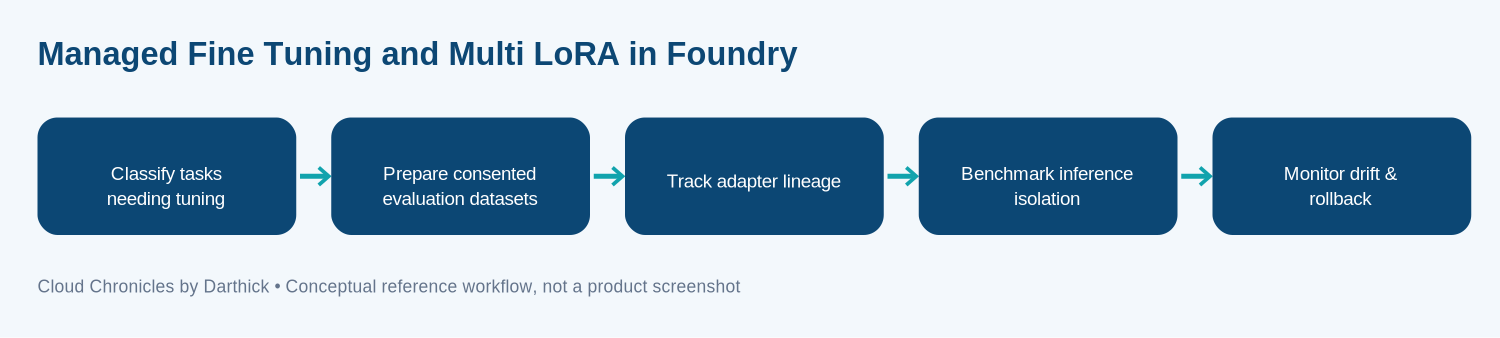
Deploying managed fine-tuning and multi-LoRA capabilities within an enterprise Azure landing zone requires a structured, multi-stage delivery pipeline. The reference architecture moves through five distinct phases, designed to ensure that model customization never compromises security, governance, or cost predictability.
Task Classification
Identify specific business functions requiring dedicated tuning versus prompt engineering or standard RAG approaches.
Dataset Curation
Prepare, sanitize, and validate consented evaluation datasets to eliminate bias, PII leaks, and training anomalies.
Lineage Tracking
Maintain strict version control over base models, hyperparameter configurations, and resulting adapter weights.
Inference Isolation
Benchmark multi-tenant serving performance to guarantee cross-adapter latency isolation and security boundaries.
This conceptual implementation sequence must be adapted to your organization’s specific cloud governance model, network topology, and compliance requirements. It is not a claim that the platform exposes these operational phases as a single monolithic native button.
Training data safeguards
Executing a successful fine-tuning initiative within enterprise environments demands rigorous adherence to design and operational checkpoints. Each phase requires clearly defined ownership, established input and output criteria, documented failure modes, strict access controls, and verifiable evidence before production promotion.
Classifying Tasks Needing Tuning
Not every enterprise problem warrants model customization. Before allocating compute quotas for fine-tuning, engineering teams must evaluate whether prompt engineering, few-shot prompting, or external retrieval augmentation can achieve the desired outcome. Tuning should be reserved for scenarios requiring deep domain syntax assimilation, specific output formatting (such as complex JSON schemas), or specialized multilingual terminology where general foundation models exhibit high error rates. Document the expected input distributions, output expectations, known failure modes, and required security reviews before initiating any training job.
Preparing Consented Evaluation Datasets
The quality of a fine-tuned adapter is entirely bounded by the quality, cleanliness, and representativeness of its training and evaluation corpora. Enterprises must establish robust data ingestion pipelines that scrub Personally Identifiable Information (PII), proprietary secrets, and toxic content from training sets. Furthermore, teams must curate held-out evaluation datasets that reflect real-world user queries rather than sanitized synthetic examples. Establish clear ownership for dataset curation, versioning, and consent verification to ensure regulatory compliance across jurisdictions.
Tracking Adapter Lineage and Versioning
In complex multi-LoRA deployments hosting dozens of active adapters concurrently, lineage tracking is non-negotiable. Every adapter artifact must be cryptographically linked to its exact base model version, training dataset snapshot, hyperparameter configuration, and evaluation benchmark score. Utilizing a centralized model registry ensures that when an adapter exhibits unexpected drift or behavioral regression, engineering teams can instantly trace its origin, audit its training logs, and roll back to a previously verified stable iteration.
Benchmarking Inference Isolation and Latency
Multi-LoRA architectures achieve efficiency by sharing GPU compute resources across multiple adapters. However, this multi-tenant serving model introduces potential performance interference under heavy concurrent load. Architects must benchmark inference latency, memory swap overhead, and throughput under peak traffic conditions. Ensure that noisy neighbor scenarios, where one high-volume adapter starves others of compute cycles, are mitigated through proper cluster sizing, request queue management, and strict resource quotas.
Monitoring Drift, Safety, and Rollback Procedures
Post-deployment monitoring of fine-tuned models requires specialized telemetry beyond standard application metrics. In addition to tracking latency, error rates, and token consumption, teams must implement automated semantic evaluations to detect behavioral drift, hallucination spikes, or safety guardrail degradation over time. A comprehensive runbook must state precisely how to isolate or disable a misbehaving adapter dynamically via API routing rules without interrupting unrelated workloads sharing the same underlying base model deployment.
Serving reliability
Enterprise AI architectures must adhere to zero-trust principles. Leverage Microsoft Entra ID for all management and data plane authentication wherever supported, enforcing strict role-based access control (RBAC) to ensure that only authorized data scientists and engineers can initiate tuning jobs or publish adapters to production registries. Store sensitive connection strings, API tokens, and storage keys securely in Azure Key Vault, ensuring secrets are never hardcoded into source repositories, configuration files, or telemetry streams.
Establish explicit network trust boundaries by deploying serving endpoints within virtual networks protected by private endpoints and network security groups. Implement data classification policies that govern how long training logs, intermediate checkpoints, and fine-tuned adapter weights are retained. Define mandatory approval gates for consequential actions, such as promoting an experimental adapter to public-facing customer channels, and assign a clear incident response owner for AI-related security anomalies.
Adapter economics
Production readiness requires systematic testing under adverse conditions. Simulate retries, partial cluster failures, upstream throttling, regional service degradation, and sudden traffic surges. Make all side-effecting infrastructure and deployment operations idempotent to prevent duplicate resource allocation during automated recovery sequences. Collect granular telemetry covering latency percentiles, error rates, token consumption, and dependency health across all integrated services.
Create and regularly test operational runbooks that address regional failover scenarios. If a primary inference region experiences connectivity issues or capacity exhaustion, automated traffic managers should be capable of routing requests to secondary regions maintaining synchronized adapter states. Operational teams must be empowered to disable or isolate faulty features instantly without destabilizing core enterprise applications.
Deployment checkpoints
Model customization and multi-tenant serving introduce complex financial considerations. Architects must estimate total expenses spanning raw infrastructure compute, API usage, storage for datasets and checkpoints, telemetry ingestion, cross-region networking, and vendor support tiers. Avoid projecting costs solely from vendor benchmarks or theoretical pricing sheets; always benchmark representative workloads using production-scale data volumes.
Set granular budget alerts and tag every resource, storage account, and cluster with appropriate cost-center metadata to maintain strict financial accountability. For features operating in preview status, verify billing structures, data transfer charges, and support SLA commitments before committing to large-scale production adoption.
Where I would draw the line
Managed Fine Tuning and Multi LoRA in Foundry represent a significant maturation in enterprise artificial intelligence architecture, offering the precision of customized models without the unsustainable infrastructure costs of full-model duplication. However, realizing this potential requires treating adapter management as a rigorous discipline encompassing data governance, strict lineage tracking, automated safety monitoring, and robust FinOps controls. Start with clear operational requirements, validate current platform contracts, and adopt capabilities incrementally backed by evidence from controlled pilots.
More articles on Gen AI are available in the blog archive.