
Availability verified: Microsoft’s Foundry model catalog lists gpt-6.1-terra as generally available, with model version 2026-10-26. The model emphasizes visual reasoning, computer-use tasks and natural writing. Check the current region availability matrix before designing a deployment; availability and supported deployment types vary.
Evaluate model adoption through benchmark-driven selection and regional deployment checks; validate current SKU availability and naming before publication in enterprise environments.
Start with the workload
Benchmark before deployment
Evaluating model adoption requires a systematic approach rooted in benchmark-driven selection and rigorous regional deployment checks. You must validate current SKU availability, naming conventions, and service level agreements before committing to production publication. A sound architectural decision must consider identity propagation, network boundaries, continuous deployment automation, comprehensive logging, data classification frameworks, disaster recovery postures, and long-term cost optimization.
Preview capabilities and newly introduced model tiers demand even greater scrutiny regarding service limits, throttling behaviors, regional capacity constraints, and vendor support commitments. Enterprise architects cannot afford to treat foundation models as black-box APIs. They must be integrated into established enterprise governance frameworks, treating model endpoints with the same rigor applied to relational database clusters or core identity providers. Understanding the underlying mechanics of Microsoft Foundry allows engineering teams to build resilient wrappers, efficient caching layers, and deterministic fallback mechanisms that protect downstream business logic from upstream model instability or latency spikes.
Rollout and fallback
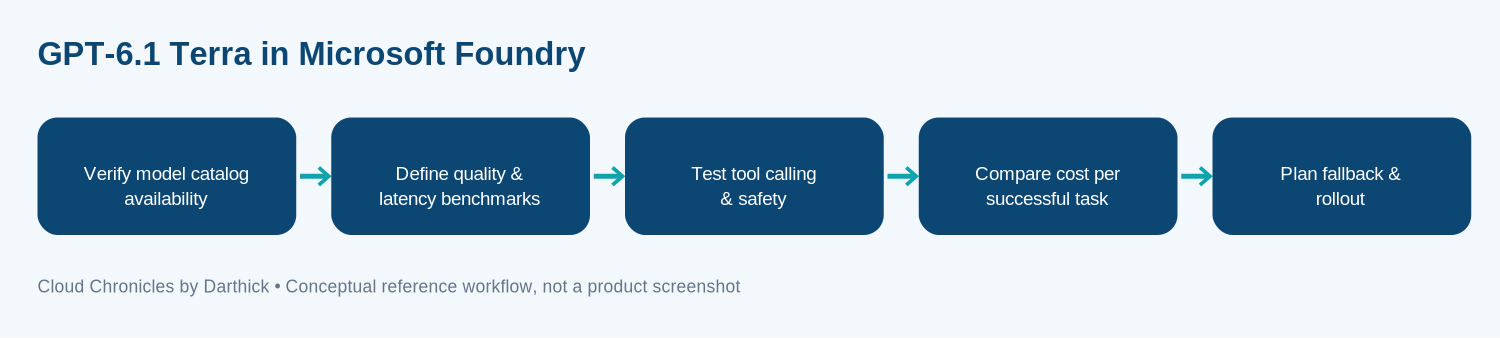
To successfully operationalize advanced language models, engineering teams need a clear conceptual delivery sequence. The implementation pattern spans multiple distinct phases, ensuring that security, compliance, and performance are baked into the deployment lifecycle from day one.
Discovery & Catalog
Verify model catalog availability, regional footprints, and API contract specifications within Microsoft Foundry.
Benchmarking
Define deterministic quality, token throughput, and latency benchmarks against representative domain workloads.
Safety & Tooling
Test tool calling reliability, prompt injection defense, and content filtering safety guardrails rigorously.
FinOps & Scaling
Compare cost per successful task, set up budget alerts, and configure automated horizontal scaling rules.
This implementation sequence is a conceptual framework designed to guide enterprise landing zones. Adapt these stages to fit your organization’s specific cloud governance model, security baselines, and CI/CD automation pipelines.
Security and governance
Deploying advanced models requires breaking down the adoption lifecycle into manageable, auditable operational checkpoints. Each checkpoint establishes clear ownership, defines expected inputs and outputs, identifies potential failure modes, enforces strict access controls, and mandates specific evidentiary documentation before production rollout.
Verify model catalog availability
Verifying model catalog availability is the foundational design and operational checkpoint. Enterprise architects must confirm that the target model variant is supported in the desired Azure regions to comply with data residency and latency requirements. This checkpoint requires defining the operational owner, documenting expected input payload limits and output token constraints, mapping potential failure modes (such as regional capacity exhaustion), enforcing role-based access control (RBAC), and gathering compliance evidence before production rollout. For this topic, apply the checkpoint specifically to GPT-6.1 Terra within Microsoft Foundry, documenting the trade-offs between fully managed cloud services and custom-hosted implementations.
Define quality and latency benchmarks
Defining quality and latency benchmarks establishes objective criteria for model evaluation. Generic vendor benchmarks rarely reflect enterprise-specific data distributions or domain-specific terminology. Architects must establish synthetic test harnesses that mirror real-world query patterns. This checkpoint involves defining the metric owner, establishing baseline accuracy thresholds, measuring time-to-first-token and total completion latency under concurrent load, documenting degradation failure modes, and capturing validation reports to justify production promotion.
Test tool calling and safety
Testing tool calling and safety ensures that the model interacts reliably with external enterprise APIs, databases, and retrieval-augmented generation (RAG) pipelines without exposing vulnerabilities. Modern language models frequently act as agents capable of executing consequential actions. This checkpoint requires defining the security owner, mapping out expected input validation schemas, simulating adversarial prompt injection and jailbreak attempts, testing deterministic tool output parsing, and verifying that content safety filters block policy-violating responses effectively.
Compare cost per successful task
Comparing cost per successful task shifts the financial conversation from raw per-token pricing to business outcome economics. An expensive model that solves a complex multi-step reasoning task on the first attempt can often be more cost-effective than a cheaper model that requires multiple retry loops and manual human intervention. This checkpoint requires defining the financial operations (FinOps) owner, calculating end-to-end task completion expenses including token consumption, storage, and networking, and evaluating cost-benefit trade-offs against alternative model tiers.
Plan fallback and rollout
Planning fallback and rollout guarantees operational continuity when primary endpoints experience degradation, throttling, or unexpected outages. No cloud service achieves absolute uptime. This final operational checkpoint requires defining the reliability owner, engineering automated circuit breakers, establishing fallback routing to secondary model endpoints or quantized smaller models, and documenting clear rollback procedures that can be executed without manual intervention during high-severity incidents.
Reliability and fallback
Enterprise AI governance demands an uncompromising security posture. When deploying GPT-6.1 Terra within Microsoft Foundry, solutions must adhere to zero-trust principles across every architectural layer.
Use Microsoft Entra ID for authentication wherever supported, completely eliminating hardcoded service accounts in favor of managed identities. Enforce strict least-privilege RBAC, ensuring that calling applications only possess permissions to invoke specific model deployments. Store all configuration secrets, API keys, and connection strings securely in Azure Key Vault, leveraging automated key rotation policies.
Establish explicit network trust boundaries by deploying endpoints within Azure Virtual Networks using private endpoints, disabling public internet accessibility entirely. Implement structured audit logging via Azure Monitor and Log Analytics, capturing metadata, token counts, and sanitized prompt headers while strictly preventing the logging of sensitive personal identifiable information (PII) or intellectual property.
Economics of model choice
Building resilient AI systems requires designing for failure from the outset. Because large language model inference is computationally intensive and subject to dynamic load fluctuations, architectures must gracefully handle transient anomalies.
Test retry storms, partial downstream failures, rate-limiting throttling responses, sudden regional unavailability, and rapid rollback procedures thoroughly in staging environments. Make all side-effecting operations triggered by model tool calls strictly idempotent to prevent duplicate database transactions or erroneous API executions during retry cycles.
Implement comprehensive observability by collecting granular metrics on inference latency, error rates, token consumption quotas, and upstream dependency health. Create a comprehensive operational runbook that details step-by-step instructions on how to isolate, throttle, or disable the AI integration safely without disrupting unrelated core platform workloads.
Rollout checkpoints
Managing cloud spend for generative AI workloads requires proactive financial oversight. Token-based pricing models can scale unpredictably if usage patterns are not tightly monitored and governed.
Set automated budget alerts and tag all associated resources with appropriate cost center metadata. For preview products and newly released model tiers, verify billing terms, consumption metering rules, and SLA commitments carefully before authorizing large-scale production adoption.
Where I would draw the line
Adopting GPT-6.1 Terra in Microsoft Foundry requires evaluating the offering as a core architectural capability rather than a simple feature checkbox. Enterprise success depends on establishing clear operational requirements, validating current service contracts, and adopting advanced AI capabilities incrementally backed by empirical evidence gathered from a tightly controlled pilot program.
Sources and documentation
Consult the Microsoft documentation and official Foundry announcements to verify the latest version details, API specifications, and related release notes before publication.
More articles on Gen AI are available in the blog archive.