Explore the public-preview managed harness for skills, MCP tools, managed execution and subagents, with clear governance and preview limitations. For Azure solution architects, the important question is not merely whether a capability exists, but whether it can be deployed safely, operated at scale, integrated with the existing platform, and retired or rolled back without unexpected operational friction.
What the harness manages
Enterprise adoption of autonomous agentic workflows introduces significant architectural complexity. Organizations must orchestrate large language model reasoning loops while maintaining strict compliance, predictable latency, and secure access boundaries. The Microsoft Copilot Harness within the Foundry Agent Service addresses these enterprise needs by providing a structured, managed execution environment. It standardizes how agent skills, Model Context Protocol (MCP) tools, and subagents interact within a unified control plane.
For Azure solution architects, evaluating this framework requires looking past marketing feature checklists. A sound production adoption strategy must systematically evaluate identity management, network isolation, deployment automation, centralized logging, data classification, and disaster recovery. Because this capability is currently in public preview, architects must pay close attention to published service limits, throttling behaviors, and support commitments from Microsoft before committing mission-critical workloads.
The tool and identity boundary
When engineering generative AI systems at scale, custom orchestration frameworks often become technical debt. Maintaining custom state machines, tool-dispatch loops, and token-budget managers requires continuous engineering effort. The Microsoft Copilot Harness in Foundry Agent Service abstracts much of this undifferentiated heavy lifting, offering a standardized runtime environment.
However, adopting a managed runtime shifts architectural responsibilities. Instead of writing custom orchestration code, architects must focus on governance, policy enforcement, and operational readiness. A sound adoption decision must consider several core architectural vectors:
Identity & Trust
Enforcing least-privilege access using Microsoft Entra managed identities across agent tools.
Network Boundaries
Securing tool endpoints and preventing unauthorized data exfiltration during execution.
Observability
Capturing structured telemetry, token consumption metrics, and tool execution traces.
Where the operational risks sit
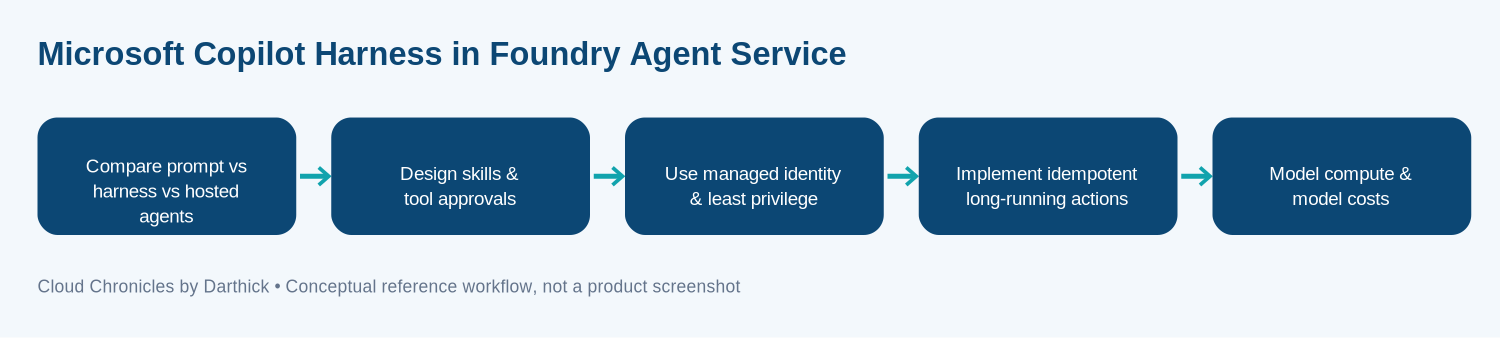
The diagram above illustrates a conceptual implementation sequence rather than a rigid product constraint. It outlines how user prompts flow through the managed harness, interact with registered skills and MCP tools, leverage subagents for specialized task decomposition, and return verified outputs to the calling application. Architects must adapt this delivery flow to match their organization’s specific Azure landing zone and governance model.
Tool authorization
Transitioning from concept to production requires rigorous evaluation across several design checkpoints. Each checkpoint defines specific operational requirements, failure modes, and security controls that must be verified before rollout.
Compare prompt vs harness vs hosted agents
Choosing the correct architectural tier is the foundational design decision. A raw prompt approach offers maximum flexibility but requires custom application code to handle tool dispatch, state persistence, and error recovery. Conversely, fully hosted agents provide out-of-the-box experiences but may lack granular control over execution parameters.
The Microsoft Copilot Harness sits in the optimal middle ground, providing a managed execution framework while granting architects fine-grained control over skill registration, tool approvals, and runtime behavior. Define the owner, expected input and output schemas, failure modes, and access controls before moving any workload past development stages.
Design skills and tool approvals
Agents derive their power from their ability to invoke external tools and APIs. However, autonomous tool execution introduces severe security risks, including unintended data modification, unauthorized resource creation, and prompt injection attacks that trigger destructive API calls.
To mitigate these risks, architects must enforce strict tool approval workflows. Implement explicit human-in-the-loop validation gates for consequential actions—such as database mutations, financial transactions, or infrastructure deployments. Ensure that every skill registered within the harness has a defined scope, explicit input validation, and a verifiable audit trail.
Use managed identity and least privilege
Hardcoded connection strings and static API keys have no place in enterprise AI architectures. Every agent instance and registered tool must authenticate using Microsoft Entra managed identities, adhering strictly to the principle of least privilege.
Assign fine-grained Azure RBAC roles to the agent’s identity, restricting access solely to the data stores, storage accounts, and backend services required for its specific function. Store secondary configuration secrets securely in Azure Key Vault, utilizing automatic rotation policies where applicable.
Implement idempotent long-running actions
Agentic workflows often involve multi-step reasoning processes that span several seconds or minutes. Network timeouts, throttling events, or transient model errors can cause the execution loop to retry, potentially leading to duplicate tool invocations.
To prevent data corruption or duplicate transactions, all side-effecting operations executed by agent skills must be strictly idempotent. Design backend APIs to accept idempotency keys, ensuring that repeated calls with identical parameters yield the exact same result without re-executing the underlying operation.
Model compute and model costs
Autonomous agent harnesses can rapidly consume token budgets through recursive reasoning loops, excessive tool polling, and large context windows. Without careful cost modeling, cloud spend can spiral out of control during complex multi-agent interactions.
Establish strict token consumption limits, configure maximum recursion depth parameters for subagent swarms, and continuously monitor token utilization across all deployed harnesses. Benchmark representative workloads in a non-production environment to establish reliable baseline cost projections before production deployment.
Telemetry and tracing
Security cannot be treated as an afterthought when deploying autonomous agents. Because agents possess the autonomy to query databases and invoke APIs on behalf of users, they represent a significant lateral movement vector if compromised.
A robust security baseline requires using Microsoft Entra identities wherever supported, enforcing least-privilege RBAC, managing secrets centrally in Azure Key Vault, and establishing explicit network trust boundaries using private endpoints. Furthermore, organizations must define a comprehensive data retention policy, mandate approval points for consequential actions, and designate a clear incident response owner. Under no circumstances should credentials, access tokens, or connection strings be exposed in source code repositories or application telemetry.
Cost and scaling
Production readiness demands rigorous failure-mode testing. Architects must simulate API throttling, downstream service outages, model latency spikes, and regional unavailability to ensure the agent harness behaves predictably under stress.
Implement robust retry policies with exponential backoff for transient failures, and ensure that partial failures in subagent tasks do not corrupt the primary session state. Collect comprehensive telemetry encompassing latency percentiles, error rates, token consumption metrics, and dependency health. Finally, establish a clear operational runbook detailing how to isolate or disable the agent harness instantly without disrupting unrelated platform workloads.
Where to use it
Financial operations (FinOps) for generative AI workloads extend beyond traditional infrastructure monitoring. Architects must account for underlying model compute, API consumption rates, supporting storage accounts, telemetry ingestion fees, networking charges, and vendor support tiers.
Never rely solely on vendor-provided pricing examples; always benchmark representative workloads using production-like data volumes. Set up granular budget alerts within Azure Cost Management, tag every resource to its designated cost center, and verify billing and SLA terms for preview products before granting production sign-off.
Where I would draw the line
The Microsoft Copilot Harness in Foundry Agent Service represents a powerful architectural advancement for enterprise AI development. However, it should be evaluated strictly as an architectural capability rather than a simple feature checkbox. Success requires aligning clear operational requirements, validating the current service contract, and adopting the framework incrementally backed by empirical evidence gathered from a controlled pilot.
Sources and documentation
Microsoft documentation and official announcement. Always verify the latest version, regional availability, and related release notes before initiating production deployments.
More articles on Gen AI are available in the blog archive.