
Retrieval quality starts with access
For Azure solution architects, the most critical question is not merely whether a capability exists within modern cloud services. It is whether that capability can be deployed safely, operated at scale, integrated cleanly with your existing platform ecosystem, and retired or rolled back without unexpected system failures. This comprehensive article presents a rigorous, practical decision framework for evaluating and implementing Work IQ Retrieve and Enterprise RAG.
Modern information retrieval within the enterprise has fundamentally evolved. Designing a robust retrieval-augmented generation pipeline requires architects to move far beyond simplistic vector-search mechanisms. Successful deployments demand sophisticated handling of identity boundaries, granular permission inheritance, uncompromised source freshness, rigorous citation accuracy, and stringent latency and cost controls. By structuring your architecture around these foundational pillars, you can avoid the common pitfalls that plague early-stage generative AI pilots.
How the retrieval path works
When organizations rush to deploy conversational AI tools across internal knowledge repositories, they frequently underestimate the complexity of data governance. Treating retrieval as a simple vector database lookup ignores the complex organizational reality of document sharing, confidential human resources materials, intellectual property protection, and strict compliance mandates. A sound architectural decision regarding Work IQ Retrieve and Enterprise RAG must consider identity management, network boundaries, deployment automation, structured logging, data classification tiers, disaster recovery procedures, and true total cost of ownership.
Preview capabilities and emerging API extensions demand additional scrutiny regarding service limits, regional availability, API versioning stability, and formal support commitments. Enterprise software engineering teams cannot afford to build fragile integrations around capabilities that lack clear deprecation policies or stable enterprise SLAs. Therefore, establishing a repeatable evaluation methodology is essential for maintaining control over your organization’s cloud expenditure and security posture.
Evaluation and observability
The architectural delivery flow for modern enterprise retrieval systems relies on a structured, multi-stage ingestion and query pipeline. While vendor documentation often presents these operations as instantaneous native features, enterprise architects must carefully design each phase to accommodate custom security filters, asynchronous document parsing, chunking optimizations, and secure model invocation boundaries.
The conceptual implementation sequence begins with secure data ingestion from authorized enterprise sources. Documents are normalized, split into semantically meaningful chunks, and indexed alongside fine-grained Access Control Lists (ACLs). During query execution, user identity tokens are validated against identity providers before any vector similarity search or keyword lookup occurs. Once relevant context is retrieved, strict grounding evaluations verify that the generated responses are supported by the retrieved citations before the final output reaches the client application.
This multi-stage flow ensures that unauthorized users cannot bypass security boundaries simply by crafting clever conversational prompts. Adapting this reference pattern to your specific enterprise landing zone and governance model guarantees long-term maintainability.
Permission boundaries
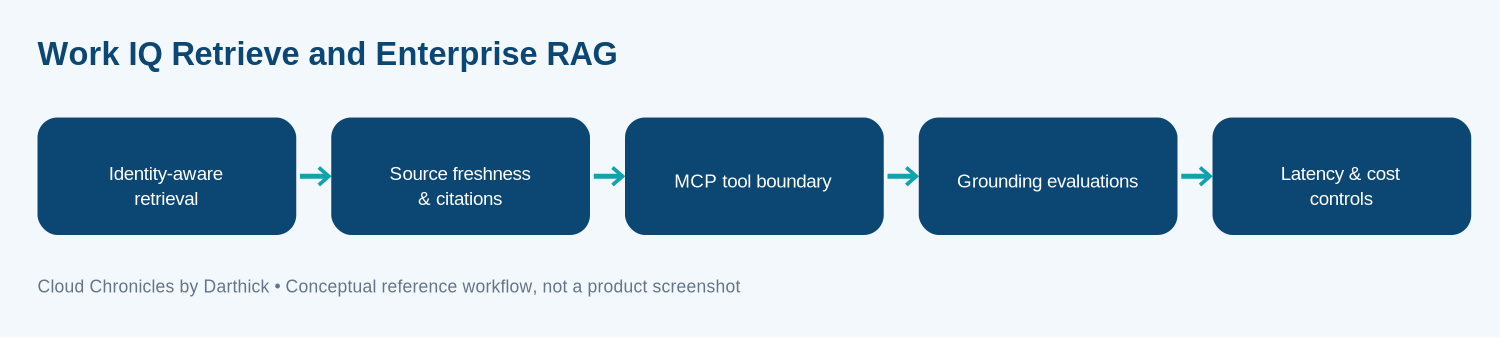
To successfully transition from a proof-of-concept to a production-grade deployment, engineering teams must master five distinct design and operational checkpoints. Each checkpoint requires clear ownership, defined inputs and outputs, comprehensive failure mode documentation, and verifiable security evidence before rollout.
Identity-aware retrieval
Identity-aware retrieval is a critical design checkpoint that ensures users only discover information they are explicitly authorized to view in their day-to-day work. Without dynamic ACL filtering at query time, generative AI applications can become accidental insider threats, exposing confidential payroll records, executive correspondence, or proprietary source code to unauthorized personnel. Define the system owner, expected input tokens, output filtering mechanisms, fallback failure modes, and security evidence required prior to production rollout. Compare managed retrieval services against custom vector database implementations to balance operational overhead with absolute security control.
Source freshness and citations
Enterprise users lose trust in conversational AI rapidly when responses rely on outdated documentation or fail to provide verifiable citations. Source freshness requires automated synchronization pipelines that detect document modifications, deletions, and policy updates in near-real-time. Simultaneously, citation engines must map every generated claim back to its exact source snippet, page number, and revision timestamp. Establishing strict metrics for citation precision and content freshness prevents hallucinations and ensures compliance with internal auditing standards.
MCP tool boundary
Model Context Protocol (MCP) tool boundaries govern how retrieval components interact with external agents, enterprise databases, and transactional APIs. Without strict boundary definitions, large language models can inadvertently trigger unintended side effects, execute unauthorized database modifications, or exceed consumption quotas. Architects must define clear protocol schemas, enforce strict read-only constraints where appropriate, and implement robust rate-limiting mechanisms to protect downstream backend systems from sudden traffic surges generated by autonomous AI agents.
Grounding evaluations
Grounding evaluations provide quantitative metrics to measure how faithfully a generated response adheres to the retrieved context. Automated evaluation harnesses should test for semantic drift, hallucinated facts, and unverified assumptions. By integrating continuous grounding checks into your CI/CD deployment pipelines, you can detect regressions in model performance whenever underlying prompts, embedding models, or system architectures change.
Latency and cost controls
Enterprise RAG pipelines introduce significant computational overhead, combining embedding generation, vector similarity searches, cross-encoder re-ranking, and large language model inference. Without deliberate optimization, user latency can degrade unacceptably, while cloud consumption costs spiral out of control. Implement caching layers for frequent queries, optimize chunk sizes to reduce token counts, and establish strict timeout thresholds to maintain a responsive, cost-effective production environment.
Retrieval quality metrics
Securing an enterprise retrieval system requires a defense-in-depth strategy that spans identity verification, secret management, network isolation, and comprehensive auditing. Always utilize Microsoft Entra identities wherever supported by the underlying services. Implement the principle of least-privilege role-based access control (RBAC), ensuring that application service principals only possess permissions to read designated indexes and invoke specific model endpoints.
Store all sensitive connection strings, API keys, and service secrets securely within Azure Key Vault, enforcing automated rotation policies where applicable. Establish explicit network trust boundaries by leveraging private endpoints, virtual network integration, and service tags, ensuring that data traffic never traverses the public internet unencrypted. Define formal data retention schedules, approval workflows for consequential automated actions, and assign a dedicated incident response owner. Never expose secrets, connection credentials, or sensitive enterprise payloads in source code repositories or unmasked telemetry logs.
Latency and cost
Production readiness goes beyond passing initial functional tests. Engineering teams must rigorously simulate adverse operational conditions, including service retries, partial downstream failures, API throttling limits, regional data center unavailability, and rapid rollback procedures. Every side-effecting operation within your retrieval and ingestion pipeline must be designed as strictly idempotent to prevent duplicate record creation during network retries.
Comprehensive observability is vital for maintaining healthy operations. Collect granular metrics covering end-to-end latency, error rates, token consumption, and dependency health across all integrated services. Construct an actionable operational runbook that explicitly outlines the exact steps required to disable, throttle, or isolate the retrieval feature without interrupting unrelated core workloads across your enterprise platform.
Rollout guardrails
Deploying large-scale retrieval architectures can introduce unpredictable financial expenditures if cost monitoring is neglected. Cloud architects must estimate infrastructure compute, vector storage consumption, embedding API calls, LLM inference token usage, telemetry ingestion, inter-region networking, and enterprise support costs before committing to production budgets.
Always benchmark your specific representative workload against realistic data volumes rather than relying solely on vendor-provided pricing calculators or generic throughput examples. Establish granular budget alerts, tag all resources by department cost center, and monitor usage trends weekly. For preview products, verify all commercial billing terms, preview pricing disclaimers, and formal SLA commitments before authorizing production enterprise adoption.
Where I would draw the line
Work IQ Retrieve and Enterprise RAG must be evaluated as foundational architectural capabilities rather than simple feature checkboxes on a software procurement list. Organizations that treat retrieval as a trivial search problem inevitably encounter severe security vulnerabilities, stale information, and spiraling operational costs.
To succeed, start with clear operational requirements, validate current service contracts, and adopt capabilities incrementally backed by concrete evidence from a controlled, secure pilot environment. By maintaining rigorous standards for identity governance, data freshness, and cost control, your enterprise can harness the full power of modern generative AI safely and sustainably.
More articles on Gen AI are available in the blog archive.