Where Copilot fits in the delivery cycle
For Azure solution architects and enterprise engineering leads, the most critical question when evaluating developer productivity tools is not simply whether a capability exists within a vendor roadmap, but whether it can be deployed safely, operated at true enterprise scale, integrated seamlessly with an existing software delivery platform, and retired or rolled back without unexpected system failures or data leaks. This article presents a comprehensive, practical decision framework for Azure DevOps and Copilot Integration, designed to guide engineering teams through the complex architectural decisions required to bridge artificial intelligence assistants with robust CI/CD pipelines and source control management systems.
As organizations increasingly adopt generative AI assistants to accelerate software development, the challenge shifts from novelty to governance. Engineering managers must balance the undeniable velocity gains of AI-driven code generation with stringent security postures, compliance mandates, and data residency requirements. This guide cuts through marketing terminology to focus on concrete architectural patterns, security baselines, operational readiness checklists, and FinOps strategies. By treating assistant integration as a core platform engineering initiative rather than a simple feature toggle, organizations can unlock developer velocity while maintaining absolute control over their intellectual property and deployment pipelines.
Repository controls before automation
Engineering leaders and enterprise architects must look beyond individual developer convenience when assessing developer assistant integrations. A sound adoption decision requires a holistic view of the software development lifecycle (SDLC), taking into account identity federation, network boundaries, deployment automation reliability, structured logging, data classification tiers, disaster recovery preparedness, and total cost of ownership. Preview and early-access capabilities demand extra scrutiny regarding service-level agreements, rate limits, data privacy boundaries, and vendor support commitments.
When code assistants interface with version control systems and work item trackers, they touch the most sensitive assets an engineering organization possesses: proprietary source code, internal documentation, architectural schemas, and deployment credentials. Without a well-designed governance framework, introducing AI tools can inadvertently expand the attack surface, introduce compliance risks via telemetry data exposure, or create bottlenecks through unverified pull requests. Architects must design solutions that enforce least-privilege access, audit all automated interactions, and ensure that human accountability remains firmly at the center of every code merge and production deployment.
A safer pull-request workflow
Implementing a secure workflow between work-tracking systems, AI assistants, code repositories, and continuous integration pipelines requires a structured, multi-stage delivery flow. Below is a conceptual five-stage architecture illustrating how requirements move from an idea to a verified production deployment under strict governance.
Work Item Ingestion
Capture requirements and user stories in Azure Boards with clear acceptance criteria and contextual tags.
AI-Assisted Drafting
Leverage Copilot to suggest initial code structures, tests, and documentation mapped directly to work items.
Scoped PR Generation
Submit code changes through pull requests under strict repository branch policies and least-privilege tokens.
Automated Pipeline Gate
Run static code analysis, security vulnerability scanners, and automated unit tests within Azure Pipelines.
This implementation sequence is a conceptual framework designed to help your team map out its governance model. Adapt these stages to your organization’s specific Azure landing zone structure, enterprise compliance requirements, and existing developer tooling ecosystem.
Developer identity
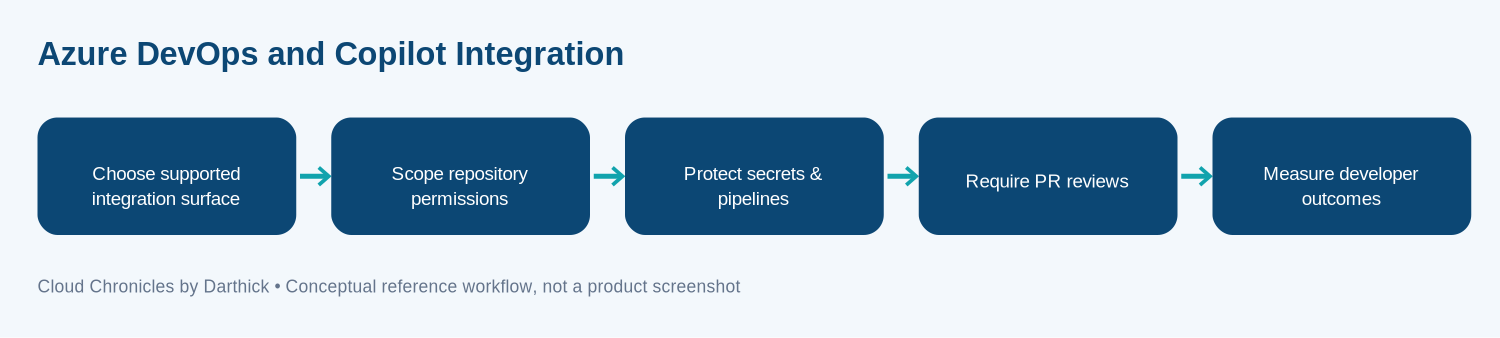
Choose supported integration surface
Selecting the correct integration surface is a foundational design and operational checkpoint. Platform engineering teams must define the designated service owner, expected inputs and outputs, failure modes, access controls, and verifiable audit evidence required before allowing any integration into a production environment. When evaluating Azure DevOps and Copilot integration pathways, architects must carefully weigh the trade-offs between fully managed platform-as-a-service extensions and custom-built API integrations. Managed surfaces typically offer streamlined authentication and vendor-backed security updates, whereas custom implementations provide granular control over data egress and prompt engineering constraints at the expense of long-term maintenance overhead.
Scope repository permissions
Scoping repository permissions correctly is critical to preventing unauthorized code access and limiting the blast radius if an integration token is compromised. Engineering teams must apply the principle of least privilege across all service connections, personal access tokens, and AI assistant integrations. Repositories containing core intellectual property or sensitive infrastructure-as-code configurations should be strictly isolated from general assistant contexts. Implement repository-level access policies that restrict assistant tooling to specific feature branches, preventing automated agents from reading sensitive main branch histories or proprietary algorithms unrelated to the active work item.
Protect secrets and pipelines
Modern CI/CD pipelines are prime targets for supply chain attacks, making secret management and pipeline security non-negotiable. Ensure that all deployment credentials, API keys, and database connection strings are stored securely in Azure Key Vault rather than hardcoded in repository files or pipeline configuration variables. When AI assistants generate pipeline YAML files or deployment scripts, automated security gates must scan the generated output for hardcoded secrets, unsafe environment variable injections, and overly permissive service connection permissions before execution is permitted.
Require PR reviews
Automated code generation can significantly increase the volume of code entering the review pipeline, making rigorous merge policies essential. Organizations must enforce strict branch policies that require mandatory peer reviews, passing automated test suites, and clean security scan results before any AI-assisted pull request can be merged into main or release branches. Reviewers should be explicitly trained to inspect generated code for subtle logic flaws, deprecated library usage, and licensing compliance issues that automated linters might fail to catch.
Measure developer outcomes
Deploying developer assistants without measuring their impact on productivity and code quality leaves engineering leaders flying blind. Establish quantitative key performance indicators, such as cycle time, pull request review duration, deployment frequency, and change failure rates, before and after integration rollout. Combine these metrics with qualitative developer feedback to continuously refine prompt engineering guidelines, training programs, and pipeline governance rules.
PR validation
A robust security posture for AI integration relies on foundational cloud-native guardrails. Utilize Microsoft Entra identities wherever supported, enforce least-privilege role-based access control (RBAC), manage all secrets centrally in Azure Key Vault, establish explicit network trust boundaries, and maintain structured audit logs for all repository and pipeline activities. Organizations must define clear data retention policies, explicit human approval gates for any consequential or side-effecting actions, and designate an incident response owner for AI-related security anomalies.
Furthermore, data classification is paramount. Ensure that proprietary source code, customer Personally Identifiable Information (PII), and internal operational telemetry are never inadvertently leaked to external model training endpoints. Enterprise agreements must guarantee that prompt inputs and generated outputs are kept private to the tenant and are not retained or used by third-party model providers for general model improvement.
Telemetry and compliance
Enterprise platforms must be resilient against partial failures, upstream throttling, and regional service degradation. Engineering teams must thoroughly test retry logic, circuit breakers, API rate-limiting behaviors, and graceful degradation paths when assistant services experience latency or downtime. All side-effecting operations, such as automated work item updates, branch creations, or pipeline triggers, must be designed to be idempotent to prevent duplicate actions during network retries.
Create comprehensive operational runbooks detailing exact steps for isolating or disabling the integration in the event of a security breach or service outage, ensuring that core development and deployment pipelines remain fully functional independently of the AI assistant.
Adoption costs
Integrating artificial intelligence into the software delivery lifecycle introduces variable cost structures that require careful financial oversight. Architects must estimate infrastructure overhead, API token consumption, storage requirements for telemetry, networking egress, and internal support costs. Rather than relying solely on vendor-provided consumption projections, teams should benchmark representative workloads against pilot environments to establish realistic baseline costs.
Establish granular budget alerts, tag all associated cost centers accurately within your Azure subscription hierarchy, and regularly review consumption trends. For preview features or newly released capabilities, verify billing models, enterprise agreement discounts, and service-level agreement terms thoroughly before committing to broad production adoption.
What I would prioritize
Integrating AI assistance into enterprise software delivery platforms like Azure DevOps is an architectural transformation, not a simple feature checkbox. Achieving sustainable velocity gains requires starting with clear operational requirements, rigorously validating current service contracts, and adopting capabilities incrementally based on evidence gathered from controlled pilot environments. By prioritizing security, least-privilege access, operational resilience, and robust governance, engineering organizations can successfully harness artificial intelligence to empower developers while safeguarding enterprise integrity.
Documentation
For the most up-to-date implementation guidelines, API specifications, and service release notes, consult the official Microsoft Azure DevOps documentation. Always verify product versions, licensing models, and regional availability before initiating enterprise-wide rollouts.
More articles on DevOps & Automation are available in the blog archive.