
Evaluate AI-assisted issue remediation through pull requests, policy checks, and evidence-based change control to drive secure, scalable, and predictable automation across your software delivery pipelines.
A failing pipeline is a signal, not permission
For Azure solution architects, the crucial question when evaluating modern tooling is not merely whether a capability exists, but whether that capability can be deployed safely, operated reliably at enterprise scale, seamlessly integrated with the existing CI/CD platform, and retired or rolled back without unexpected operational friction. This article presents a practical decision framework for Agentic Autofix for Azure DevOps.
As development teams face increasing pressure to resolve security vulnerabilities, linting errors, and dependency alerts quickly, automated remediation offers a compelling path forward. However, autonomous code modification introduces unique governance and architectural challenges. Without structured guardrails, automated agents can introduce regressions, violate compliance policies, or corrupt repository states. By implementing rigorous code remediation safety architectures, enforcing repository policies, maintaining strict pull request approvals, handling secrets securely, and ensuring deterministic rollback mechanisms, organizations can harness the power of agentic tools while retaining absolute control over their codebases.
The proposed-fix loop
Evaluating AI-assisted issue remediation requires a holistic view across several core architectural domains. A sound adoption decision must carefully consider user identity management, network boundaries, deployment automation pipelines, comprehensive logging, data classification standards, disaster recovery protocols, and total cost of ownership. Preview capabilities deserve extra attention regarding service limits, API rate restrictions, and vendor support commitments.
Architects must look beyond vendor marketing claims and examine how agentic autofix tools interact with underlying code repositories. Key considerations include determining whether the agent operates within isolated execution environments, how code patches are validated before submission, and what level of auditability is preserved when changes are merged. Establishing clear boundaries between human oversight and automated execution ensures that velocity gains do not come at the expense of system stability or regulatory compliance.
Approval and rollback
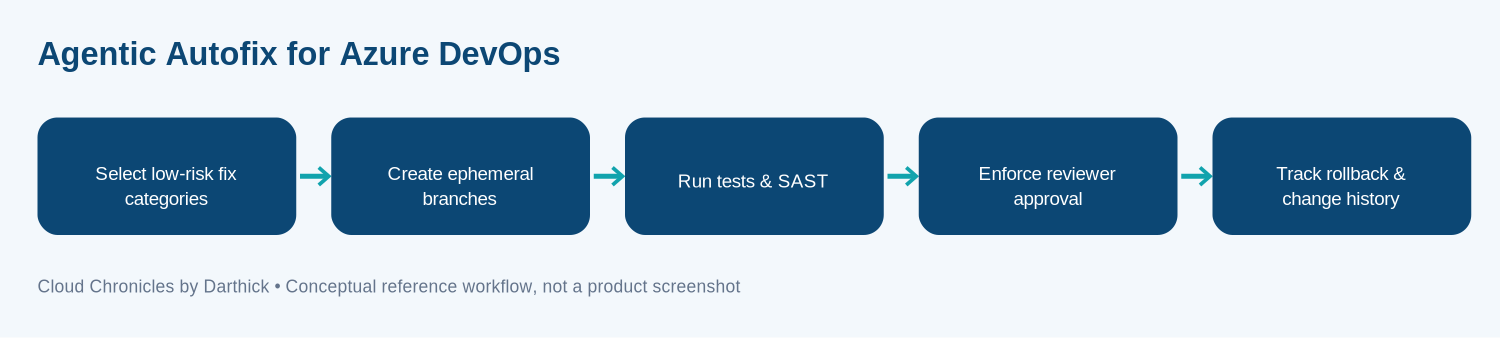
Understanding the conceptual flow of agentic remediation helps engineering teams design resilient landing zones. The workflow typically begins with automated code scanning or static application security testing (SAST) identifying a vulnerability or code smell. Once an issue is detected, the agentic engine analyzes the context, generates a proposed fix, validates the patch in a secure sandbox, creates an isolated branch, and submits a pull request for human review.
This multi-stage delivery pipeline ensures that no automated modification bypasses standard organizational quality gates. Adapting this conceptual model to your organization’s specific Azure DevOps landing zone requires mapping out precise integration points with Azure Repos, Azure Pipelines, and external monitoring systems.
Access boundaries
Implementing agentic autofix capabilities effectively requires breaking down the adoption journey into discrete, manageable design and operational checkpoints. Each checkpoint must define clear ownership, expected inputs and outputs, failure modes, access controls, and verifiable evidence required before progressing to production rollout.
Select low-risk fix categories
Define exact remediation scopes, targeting formatting fixes, dependency version bumps, and well-defined syntax errors before attempting complex logic refactoring.
Create ephemeral branches
Isolate all automated changes within dedicated short-lived branches to prevent direct commits to protected main or release branches.
Run tests and SAST
Mandate comprehensive unit test execution and static security scans against every proposed patch before opening pull requests.
Enforce reviewer approval
Require mandatory human peer review and sign-off for every AI-generated pull request to maintain institutional accountability.
Track rollback and change history
Maintain immutable audit logs of all automated modifications, enabling rapid reversion if unexpected regressions emerge downstream.
Testing generated fixes
Security must be embedded into the foundation of any agentic automation initiative. Utilizing Microsoft Entra ID for federated authentication ensures that all actions performed by autonomous agents are traceable to specific service principals with well-defined lifecycles. Organizations must strictly adhere to the principle of least-privilege Role-Based Access Control (RBAC), restricting agent permissions solely to the repositories and pipelines required for their designated tasks.
Secret management represents another critical vector. Under no circumstances should database connection strings, API keys, or personal access tokens be hardcoded into agent prompts or source code repositories. Instead, all sensitive credentials must be securely managed via Azure Key Vault, injected dynamically at runtime, and scrubbed from telemetry outputs. Explicit network trust boundaries must be maintained, ensuring that agent execution environments operate within isolated virtual networks with restricted egress traffic.
Furthermore, establishing a clear data retention policy is essential. Teams must determine how long contextual code snippets sent to AI models are stored by third-party processors and whether those snippets comply with internal data classification standards. Designating an explicit incident response owner ensures that if an automated remediation injects vulnerable or malicious code, the organization can respond immediately.
Audit evidence
Operational resilience requires rigorous testing of edge cases, including API throttling, partial service outages, regional unavailability, and rapid rollback procedures. Because agentic systems rely heavily on external model endpoints, network latency and intermittent connection failures must be anticipated and handled gracefully through robust retry logic and exponential backoff mechanisms.
All side-effecting operations performed by remediation agents must be strictly idempotent. If a pipeline fails midway through a multi-file refactoring task, re-running the workflow should reconcile the state without duplicating changes or leaving repositories in a corrupted intermediate state. Engineering teams should collect granular telemetry covering latency, error rates, token consumption, and dependency health.
A comprehensive operational runbook must be established, detailing exact steps to disable, isolate, or bypass the autofix feature without interrupting standard human-driven development workflows. This ensures that operational teams retain full control during platform incidents.
Rollback ownership
Adopting agentic AI capabilities introduces variable cost structures that require proactive financial management. Unlike traditional compute resources with predictable licensing fees, agentic autofix solutions often incur costs based on API invocation volume, token consumption, storage utilization, telemetry ingestion, and networking overhead.
To prevent budget surprises, teams should benchmark representative workloads against historical issue volumes rather than projecting costs solely from vendor examples. Implementing proactive budget alerts, tagging cost centers accurately within Azure Cost Management, and conducting monthly FinOps reviews ensure that the return on investment from reduced remediation time outweighs operational expenses. For preview products, verifying billing models and service level agreements (SLAs) before production adoption is mandatory.
What I would prioritize
Agentic Autofix for Azure DevOps represents a powerful evolution in automated software maintenance, but it must be approached as a comprehensive architectural capability rather than a simple feature checkbox. Success depends on establishing rigorous operational requirements, verifying current service contracts, and adopting automation incrementally backed by evidence gathered during controlled pilots. By prioritizing security, governance, and reliability from day one, engineering organizations can unlock unprecedented developer velocity while maintaining absolute trust in their code delivery pipelines.
Documentation
For further technical details, consult the official Microsoft Azure DevOps documentation. Always verify the latest product version, API specifications, and related release notes before initiating enterprise deployment.
More articles on DevOps & Automation are available in the blog archive.