
Failure modes that matter
Modern cloud architecture increasingly relies on autonomous and semi-autonomous AI agents to handle intricate, multi-step workflows. These workloads span data ingestion, complex analysis, real-time code execution, and external API orchestration. Because these tasks frequently require minutes or hours to complete, they are inherently vulnerable to network glitches, transient service throttling, infrastructure updates, and sudden node recycling. Without a rigorous strategy for maintaining work state and recovering gracefully from unexpected interruptions, production agent systems will inevitably fail, leading to duplicated operations, inconsistent data states, and frustrating user experiences. This guide breaks down the essential principles of checkpointing, idempotency, robust error handling, and operational readiness for hosted agent environments.
State and replay protection
Design long-running agent workloads with checkpointing, idempotency, and durable execution semantics. A sound adoption decision should consider identity, network boundaries, deployment automation, logging, data classification, disaster recovery, and total cost of ownership. Preview capabilities deserve additional attention to service limits and support commitments.
When an agent executes an open-ended plan, it interacts with various stateful and stateless components. If a worker node crashes mid-stream, perhaps due to a platform patch or an unhandled transient exception from a third-party model endpoint, the financial and operational cost of restarting the entire workflow from scratch can be prohibitive. Furthermore, if the agent has already performed side-effecting operations like updating a database record or dispatching an email notification before the crash occurred, a naive restart might duplicate those actions. Architects must look beyond basic API connectivity and establish deep architectural patterns that treat agent execution state as a first-class citizen.
Recovery drills
The conceptual implementation sequence outlined below establishes a structured path for managing long-running agent tasks. Adapt this sequence to your organization’s specific landing zone and governance model to ensure compliance with internal security mandates.
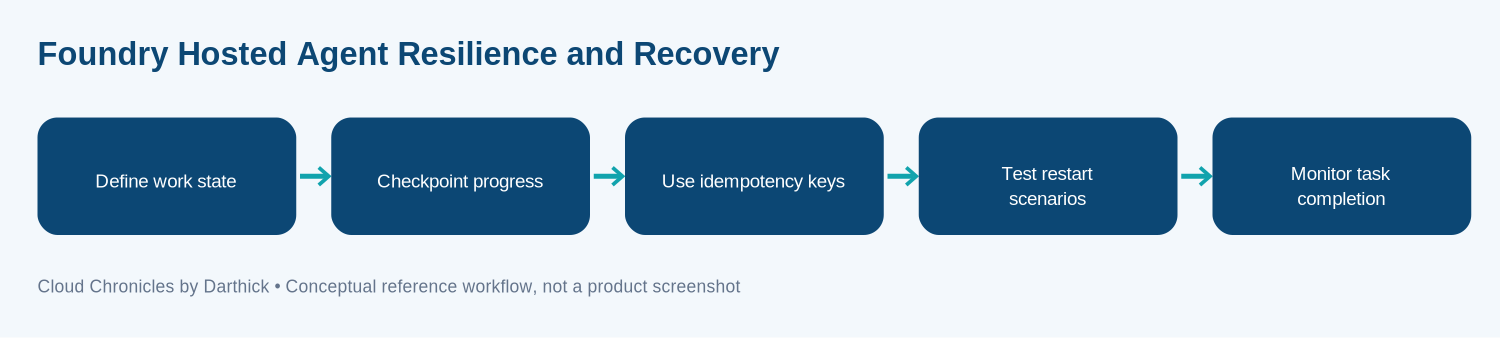
The reference delivery flow progresses through five discrete stages:
Define Work State
Establish the strict schema, input parameters, and expected outcomes required before any agent execution begins.
Checkpoint Progress
Persist intermediate reasoning steps and tool outputs incrementally to durable storage to survive sudden worker failures.
Use Idempotency Keys
Ensure that retrying failed network calls or restarting interrupted tasks never causes duplicate side-effects.
Test Restart Scenarios
Simulate abrupt node termination and network partitions in staging to validate recovery paths.
Monitor Task Completion
Track execution metrics, token consumption, and failure rates to catch anomalies before they impact end users.
Agent identity
Define Work State
Define work state is a distinct design and operational checkpoint. Define the owner, expected input and output, failure modes, access controls, and evidence required before production rollout. For this topic, apply the checkpoint to foundry hosted agent resilience and recovery, then document the trade-off between managed services and custom implementation. When creating complex agent workflows, ambiguity in state representation is the root cause of countless silent failures. Every agent session should begin by serializing its initial configuration, environment variables, user prompt parameters, and security context into a strongly typed data structure.
Checkpoint Progress
Checkpoint progress is a distinct design and operational checkpoint. Define the owner, expected input and output, failure modes, access controls, and evidence required before production rollout. For this topic, apply the checkpoint to foundry hosted agent resilience and recovery, then document the trade-off between managed services and custom implementation. As an agent iterates through planning, tool calling, and response synthesis, its memory grows. Rather than keeping this entire history exclusively in volatile container memory, engineers must implement periodic or event-driven state snapshots. Writing these snapshots to a high-throughput, low-latency datastore ensures that if a pod is evicted, a replacement pod can rehydrate the agent’s exact cognitive state in milliseconds.
Use Idempotency Keys
Use idempotency keys is a distinct design and operational checkpoint. Define the owner, expected input and output, failure modes, access controls, and evidence required before production rollout. For this topic, apply the checkpoint to foundry hosted agent resilience and recovery, then document the trade-off between managed services and custom implementation. Real-world systems frequently encounter transient network timeouts where an agent’s request reaches a downstream API, but the acknowledgment packet gets lost in transit. Without idempotency keys embedded in the HTTP headers or payload, the agent framework will naturally retry the request, potentially charging a credit card twice, creating duplicate customer accounts, or posting redundant log entries.
Test Restart Scenarios
Test restart scenarios is a distinct design and operational checkpoint. Define the owner, expected input and output, failure modes, access controls, and evidence required before production rollout. For this topic, apply the checkpoint to foundry hosted agent resilience and recovery, then document the trade-off between managed services and custom implementation. Theory is no substitute for empirical validation. Engineering teams must practice intentional chaos engineering. By randomly killing agent worker containers during active tool execution phases, architects can verify whether the recovery routines successfully detect orphan locks, re-establish connection pools, and resume processing from the last valid checkpoint without human intervention.
Monitor Task Completion
Monitor task completion is a distinct design and operational checkpoint. Define the owner, expected input and output, failure modes, access controls, and evidence required before production rollout. For this topic, apply the checkpoint to foundry hosted agent resilience and recovery, then document the trade-off between managed services and custom implementation. Observability for agentic systems goes beyond traditional CPU and memory utilization graphs. Operators need visibility into agent-specific metrics, such as tool invocation success rates, average reasoning steps per task, token burn velocity, and frequency of recovery fallbacks. Setting up automated alerts on these indicators ensures operational teams remain proactive.
Retries and idempotency
Use Microsoft Entra identities wherever supported, least-privilege RBAC, managed secrets in Azure Key Vault, explicit network trust boundaries, and structured audit logs. Define a data retention policy, approval points for consequential actions, and an incident response owner. Do not expose credentials in source code or telemetry.
Agent workloads often possess broad capabilities, including the ability to query internal databases, invoke enterprise APIs, and generate executable code snippets. Consequently, securing these workloads requires strict adherence to the principle of least privilege. Assign narrow, role-based access control (RBAC) permissions to each hosted agent instance. Ensure that secrets such as database connection strings and API keys are never hardcoded into prompts or configuration files, but are instead retrieved securely at runtime from Azure Key Vault using managed identities. Furthermore, maintain comprehensive audit trails that record every tool invocation, input parameter, and output response, allowing security teams to reconstruct agent actions during forensic investigations.
Monitoring recovery
Test retries, partial failure, throttling, region unavailability, and rollback. Make side-effecting operations idempotent. Collect latency, error rates, consumption, and dependency health. Create a runbook that states how to disable or isolate the feature without interrupting unrelated workloads.
Operational readiness is the bridge between a successful proof of concept and a dependable enterprise deployment. When designing resilient agent workflows, architects must account for upstream and downstream throttling, especially when interacting with rate-limited foundation model APIs. Implementing exponential backoff with jitter prevents thundering herd problems when a shared service recovers from an outage. Additionally, build circuit breakers around external tool integrations so that if a specific API begins throwing continuous 500 errors, the agent can gracefully degrade its functionality or notify a human operator rather than burning through token budgets in an infinite retry loop.
Capacity planning
Estimate infrastructure, API usage, storage, telemetry, networking, and support costs. Benchmark a representative workload rather than projecting from vendor examples alone. Set budget alerts and tag the cost center. For preview products, verify billing and SLA terms before production adoption.
Agent workloads can introduce unpredictable cost spikes. Because agents frequently execute multiple reasoning loops and invoke models iteratively, a single complex user request can generate dozens of background API calls. FinOps teams must establish strict token consumption quotas per session, monitor storage growth driven by frequent state checkpointing, and implement granular cost center tagging across all associated Azure resources. Benchmarking realistic workloads under load testing conditions provides much more reliable cost projections than relying on theoretical vendor pricing models.
What I would prioritize
Foundry Hosted Agent Resilience and Recovery should be evaluated as an architectural capability, not a feature checkbox. Start with clear operational requirements, validate the current service contract, and adopt incrementally with evidence from a controlled pilot.
Documentation
Microsoft documentation or official announcement. Verify the latest version and related release notes before publication.
More articles on Gen AI are available in the blog archive.